
Farmers Wait Out Close Election, Says Federated Farmers
Farmers will wait it out like the rest of the country as the composition of the incoming government remains up in the air.
 increase font size
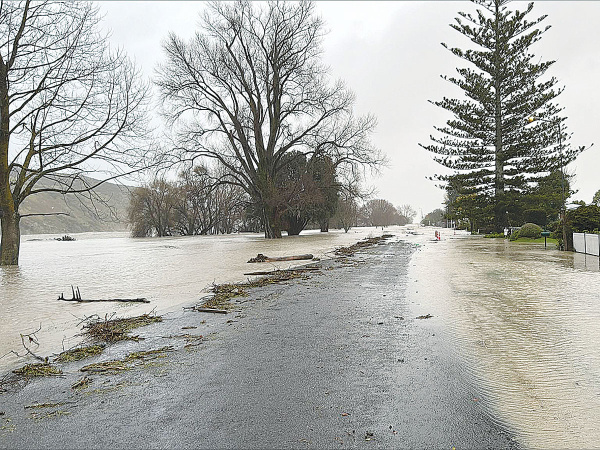 For Wairoa farmers, the recent rains affect morale, says Federated Farmers. Photo Credit: HBRC Facebook Page.
Admit that you stuffed up and apologise to the people of Wairoa.
That's the message from Federated Farmers president for Wairoa and Gisborne, Charlie Reynolds, to the Hawke's Bay Regional Council (HBRC) for not opening the bar at the river mouth which led to many residents in the township being flooded out.
Reynolds says while the recent flood affected mainly the township of Wairoa, there were problems for farmers. He says the local Affco freezing works ran low on water supplies for a time, which meant they could not operate at full capacity.
He says he's heard from farmers who had their processing dates rescheduled. "Answers need to be had quickly from HBRC and I don't mean sitting down and having a review and getting another group of people to sit down and eat sausage rolls. There needs to be an admission from the chair of HBRC that they stuffed up and caused the flooding," he says.
Reynolds believes part of the problem for Wairoa is that the HBRC is not based in the town and that it tends to focus on issues in the greater Napier and Hastings area. He says, for Wairoa farmers, the recent rains affect morale. He says one day they repair a fence and two days later it's washed away.
From what he's heard, some Wairoa farmers have suffered washouts and he also points to the fact that the Tiniroto road - the inland route that links Wairoa to Gisborne - has been out for much of the past year and the alternative route he describes as "not very nice".
While Wairoa farmers appear to have dodged a bullet with the recent rains, those around Gisborne, especially those on and around SH2 between Gisborne and Opotiki, have been badly affected.
Reynolds, who lives in that area, says the recent storm was worse for many farmers there than it was when Cyclone Gabrielle struck. He says access to some farms has been cut and infrastructure on these farms damaged.
He says he's got a personal beef with the Gisborne District Council over the clearance of logs from the Waimata River. He claims the logs were dragged out of the river and stacked on the banks. "But when the recent rains came, the logs got washed back into the river again and have ended up on local beaches," he says.
Overall, Reynolds says he's very pleased with the way the Government has responded to the plight in Wairoa. He says they acted quickly and provided much needed financial assistance and have tried to get answers from HBRC as to why the mouth of the Wairoa River was not cut in time to avoid the disaster that eventuated.
Farmers will wait it out like the rest of the country as the composition of the incoming government remains up in the air.

OPINION: The Government's decision to reinstate agriculture and horticultural science as a standalone subject from Year 11 is the right one.
With less than a week to go before voters choose the next government, Federated Farmers has a simple message to its members - get out and vote.
Federated Farmers has welcomed new rural policies released by ACT, saying they align closely with its own election priorities.
A farmgate milk price of $10/kgMS this season is firming up as milk powder prices soar and the New Zealand dollar weakens.



During the nesting season, from September to December, industrious starlings can quickly build nests in the darker areas behind tractor and vehicle, usually close to hot engines, typically resulting in localised damage or in some cases complete write-offs.
The meat processing industry is much more collegial than it was in the past and is now more focused on common goals.
With the last couple of months having seen some potential tractor purchases put on hold with the impending election and continued input cost rises, year-to-date figures, ending September, has seen deliveries up around 5% over the same period in 2025, with a total of 2026 units.
Beef+Lamb New Zealand is calling for nominations for director roles in the Northern South Island and Northern North Island electoral districts.
Fonterra chief executive, Richard Allen says being resilient has helped the dairy industry overcome extreme volatility in recent years.
The head of the Ministry for Primary Industries (MPI) trade and international relations group says New Zealand is well-positioned to secure trade access and compete internationally as the world becomes more complicated, demanding and uncertain.