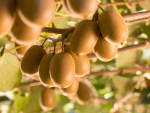
NZKGI Responds to Migrant Worker Exploitation Reports
Where any worker in the kiwifruit industry is mistreated, we expect the authorities to take action.
 increase font size
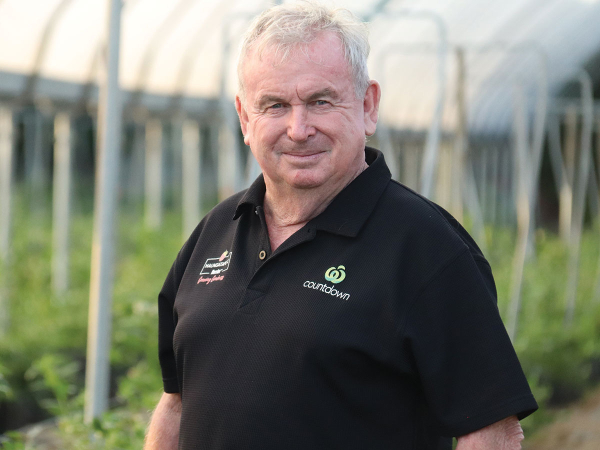 Northland blueberry grower Dermott Malley.
New Zealand needs to make sure that it continues to focus on its own food security, according to HortNZ board member and blueberry grower Dermott Malley.
He says NZ cannot just rely on international freight delivering canned food from other countries to us and says the importance of our vegetable sector cannot be overestimated.
His comments come as concerns grow about highly productive land going into housing and vegetable processing plants facing closure, as well as trees replacing sheep on our hill country.
Malley told Rural News that it's costly to produce food in NZ and there is an ongoing need to increase crop yields by introducing new and better plant varieties to counter this.
Also, New Zealand needs to look at the distribution of value along the food chain to make sure growers remain financially sustainable.
He says there are also other issues in Northland where his orchard is based.
"One of the issues is making sure we have enough water, and the other one is releasing some of the Māori land so that it can be more productive.
"To do that there needs to be an appropriate investment structure, because that land is currently not in a high production and to change that will require capital investment and require the development of new infrastructure," he says.
With Māori land, says Dermott, there is a need to understand that they will not sell their whenua and new economic structures need to be created so that new capital can be injected without that being linked to debt on their land.
Rural News is aware that this has already happened in Māoridom with iwi joining forces, especially in the kiwifruit sector, to create larger and profitable entitites.
In terms of blueberries, Malley says his company already has a high tech packhouse which is quite capable of handling all the expansion. He says they also see the potential for growing kiwiberries.
Malley says if NZ is to increase its horticultural exports it must have the same access to new plant varieties as our competitors.
He says he fully accepts the need for a quality biosecurity regime and the need to manage risk and not bring anything into NZ that would destroy the hort sector.
He says this is also linked to an expectation of our customers that we are moving to a softer approach to deal with managing diseases. In the past, much greater use has been made of 'hard' chemicals.
Malley says this means that if we bring in overseas material, we need to be sure that it will fit within our system of managing diseases and pests.
"We need to look at perhaps shifting our focus as a country to getting a guarantee those pests are better managed offshore, rather than just presuming that they are. That means we need to insist that those people overseas show us that they have done the right thing, in terms of what we do, like monitoring our crops every week," he says.
Where any worker in the kiwifruit industry is mistreated, we expect the authorities to take action.

Kiwifruit growers are watchful but remain optimistic as concerns around the potential effects of the El Niño weather pattern this season.
The New Zealand Institute of Forestry (NZIF) says unnecessary changes to New Zealand’s Emissions Trading Scheme (NZ ETS) will seriously erode investor confidence and result in significant reductions in forest planting rates.
Farms across the upper North Island are trialling different pasture mixes as part of a research programme that aims to build greater resilience into farming systems.
James Blair, an agronomist for AS Wilcox and the Pukekohe regional champion, has won the 2026 Young Grower national title.


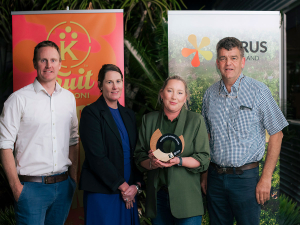
New Zealand's citrus growers were challenged to build their future on the value embedded in their fruit rather than the volume they produce, at Citrus New Zealand's annual gathering in Gisborne on 17 September.
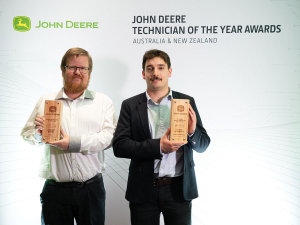
Leading John Deere technicians and apprentices from New Zealand and Australians were recognised at the recent sixth annual JD Technician of the Year Awards, held in Brisbane.
In Dacre, near Invercargill in New Zealand’s South Island, Bruce Dinnington is running a dairy operation unlike any other.
A free online platform aggregating governance vacancies across rural and regional New Zealand has been launched.
Environment Minister Nicola Grigg has announced details of a new rural plastics recycling scheme.
Agricultural drone operators say that a government decision to allow lower-risk drone work without certification won’t lower standards but drive innovation and efficiency.



