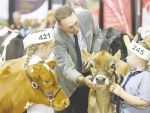
Buzz building around sale - organiser
The energy building among the industry's young people in the lead-up to the autumn harvest sale has already proven to sale organisers that they did the right thing by instigating it.
 increase font size

FARM SALES WERE up 47.3% (133 farms) for the three months ending November 2013, compared to the same period in the previous year, says the Real Estate Institute of New Zealand (REINZ).
Overall, there were 414 farm sales in the three months to end of November 2013. A total of 1,674 farms were sold in the year to November 2013, 18.1% more than in the year to November 2012.
The median price per hectare for all farms sold in the three months to November 2013 was $24,056 compared to $22,885 recorded for three months ended November 2012 (+5.1%). The median price per hectare fell 2.2% compared to October.
Compared to November 2012 the REINZ All Farm Price Index rose by 4.8%. The REINZ All Farm Price Index adjusts for differences in farm size, location and farming type compared to the median price per hectare, which does not adjust for these factors.
Eleven regions recorded increases in sales volume for the three months ended November 2013 compared to the three months ended November 2012. Southland recorded the largest increase in sales (+34 sales), followed by Waikato (+28 sales) and Bay of Plenty (+24 sales). Two regions recorded decreases in sales volume with Nelson recording the largest fall (-14 sales), followed by Gisborne (-4 sales). Compared to the three months ended October 2013 12 regions recorded an increase in sales.
"The conclusion of numerous marketing programmes during the past month has resulted in a significant lift in the volume of farm sales for the November period," says REINZ rural spokesman Brian Peacocke. "Prices across the board for dairy properties have firmed, with a clear emphasis on quality and location.
"Demand for properties with mixed contour, a lower standard of improvements or less favourable locations is evident, but at reduced price levels."
Noteworthy points include:
• 'Spectacular' prices have been paid for select properties in prime locations, particularly in the main dairying areas of Waikato, Taranaki, Canterbury and Southland.
• Price resistance from some purchasers is now an emerging issue at the upper end of the market.
• Areas such as Rotorua/Taupo, Northland and Otago are experiencing a strong increase in activity as those seeking a higher return on investment and first farm buyers focus on regions where lower prices prevail.
• Demand for land suitable for dairy conversion in the South Island continues to put pressure on supply, with dairy support properties being pushed further into fringe areas.
• Demand for good sheep and beef properties is strong in Hawkes Bay, Canterbury, Otago and Southland, particularly in the 5,000 – 10,000 su range. Prices generally range from $7,000 - $10,000 per hectare, with values as high as $15,000 - $23,000 per hectare at the top end of the finishing/grazing market.
• The horticultural market in Auckland, Bay of Plenty and Marlborough continues at a steady level.
Grazing properties accounted for the largest number of sales with 43.5% share of all sales over the three months to November. Finishing properties accounted for 19.8%, dairy properties accounted for 16.7% and horticulture properties accounted for 9.4% of all sales. These four property types accounted for 89.4% of all sales during the three months ended November 2013.
The energy building among the industry's young people in the lead-up to the autumn harvest sale has already proven to sale organisers that they did the right thing by instigating it.
OPINION: FARM (Facts About Ruminant Methane) is a group of farmers and scientists who question the need for drastic cuts in ruminant methane. Owen Jennings prosecutes FARM’s argument in the second of a two part opinion piece…
OPINION: F.A.R.M. (Facts About Ruminant Methane) is a group of farmers and scientists who question the need for drastic cuts in ruminant methane. They argue that there is a natural cycle where the emitters of a GHG (methane) use as much as they emit to grow the grass the cows need to produce the methane and thus puts ruminant methane in a different category to fossil fuel emissions.
A record number of farmers took part in the largest service bull sale in New Zealand – many from the comfort of their own homes.
There are many ways to acquire the new machinery you need to have working your land and herds.


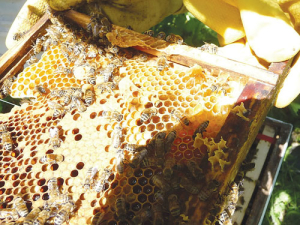
New Plymouth-based Manuka honey exporter Egmont Honey has completed its acquisition of Taihape beekeeping business Tweeddale's Honey, with settlement finalised on Friday, 18 September.

Westpac NZ is calling on farmers and growers to start preparing now for the possibility of a dry summer, as likely El Niño conditions raise the risk of drought across parts of the country.
Fonterra Co-operative Group has confirmed the independently assessed candidates standing for election to its board in 2026.
Fonterra has revised its Farmgate Milk Price forecast for the 2026/27 season, lifting the midpoint and narrowing the range on the back of improving global dairy commodity prices.
New Zealand's citrus growers were challenged to build their future on the value embedded in their fruit rather than the volume they produce, at Citrus New Zealand's annual gathering in Gisborne on 17 September.
Leading John Deere technicians and apprentices from New Zealand and Australians were recognised at the recent sixth annual JD Technician of the Year Awards, held in Brisbane.




