Federated Farmers Praises Labour's Emissions Tax Backdown
For the first time in a quarter of a century, Federated Farmers has something positive to say about the Labour Party’s climate change policy leading into a general election.
 increase font size
 Lockwood Smith wants a complete change in strategy for measuring methane emissions from animals.
Farmer and former politician Sir Lockwood Smith is questioning the way that methane emissions from livestock are measured in NZ.
Smith, respected as an agricultural scientist, farmer and politician, says the present system of measuring methane emissions by way of an accounting target approach is wrong. He says no one questions the need for emissions to be reduced, but he says the present system will one day end in tears.
"What needs to happen is a complete change in strategy internationally for methane emissions from animals, with the focus being on the 'carbon efficiency' of the food that we produce," he told Rural News.
Smith says NZ has got to start lobbying the United Nations Intergovernmental Panel on Climate Change (IPCC) to start looking at food production differently. He says shifting the focus to the carbon efficiency of food being produced and ensuring it's produced in the most carbon efficient way will benefit climate change. "Even if NZ alone decided to change the focus to carbon efficiency in food, this would make little difference. What NZ must do is get out there and influence global thinking on the subject and get buy-in from other countries," he says.
According to Smith, some of the solutions being proposed for reducing methane in our livestock - such as vaccines and boluses - are not as good as they sound. He points to the problem that worms in animals are developing resistance to drenches and believes the same could happen with things like vaccines.
He says NZ has ways of farming that are so much more efficient and notes that the big challenge in carbon efficiency is to make sure that more of what a ruminant animal consumes goes into production compared to the maintenance of the animals' body.
"That's what delivers efficiency," he says.
One way of improving carbon efficiency on NZ farms says Smith is to slaughter beef animals much sooner than we do. He says now too many 'old' animals are being slaughtered and keeping a cattle beast for three years is not workable if you want to increase carbon efficiency.
"Why not slaughter a beast at 18 months? That would make a huge improvement on carbon efficiency," he says.
For the first time in a quarter of a century, Federated Farmers has something positive to say about the Labour Party’s climate change policy leading into a general election.

Election years are always a concerning time for farmers, according to DairyNZ chair Tracy Brown.
Climate, nature and animal wellbeing make up Fonterra's refreshed sustainability roadmap released last week.
Researchers at Massey University are using a special piece of scientific equipment to improve the measurement of greenhouse gas emissions from pasture soils.
Beef+Lamb New Zealand and the Ag Emissions Centre have launched a new research project aimed at helping beef farmers reduce methane emissions without impacting productivity or profitability.


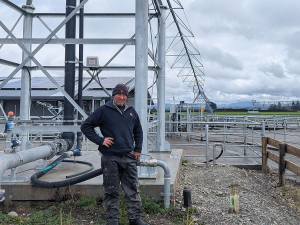
Converting a longstanding cropping farm to dairy was the only way to ensure the land stayed in the family long term, says new dairy farmer Rod May.
As the election heats up, Organics Aotearoa New Zealand (OANZ) has launched its election scorecard designed to help voters wanting to support policies that grow organic and New Zealand's organic sector.
A 'tsunami' of milk from key exporting countries is winding down and this may be good news for New Zealand dairy farmers.
Will the good times last? That's one of the key issues to come out of the latest Federated Farmers confidence survey.
Outgoing Fonterra Co-operative Council chair John Stevenson says that it has been a privilege to represent the co-op's farmer shareholders.
Have a plan in place for your cows and staff.