Buzz of new Southern Series to lift shearing sports
Competitive shearing is about to be boosted with the launch of a new competition, The Southern Series.
 increase font size
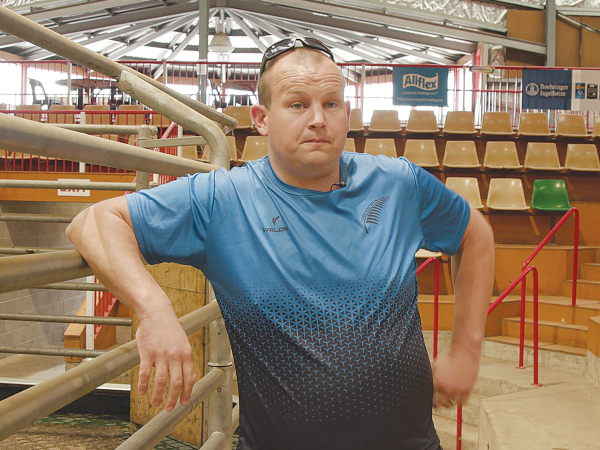 Banks Peninsula farmer and NZ Corriedale Championships organiser James Dwyer says he supports TSS because he’s had enough of wool being ignored.
The battle to get wool carpets into public buildings has taken another step with the launch of The Southern Series (TSS) elite shearing competition circuit.
TSS aims to build a global audience for competition shearing as well as raise the profile of wool.
It particularly aims to push strongwool, which comprises 85% of the New Zealand clip and is mostly used in the carpet and furnishings sector where it competes with synthetic carpets.
The 2023 series will start in Waimate in October, with back-to backevents on the 6th and 7th. It finishes with the NZ Corriedale Championships at the NZ Agricultural Show in Christchurch on November 17th.
After being successfully trialled at last year’s NZ Corriedale Championships, this year’s threeshow TSS circuit is the next stage in the roll-out of a global shearing competition circuit, taking in shows in Australia, the UK, Europe, Canada and the US, with the annual final in Christchurch.
TSS supports the calls for wool carpets to be used in public buildings and schools in New Zealand because they are a natural fibre with a much lower carbon footprint, are fully bio-degradable and perform and last as well as or better than synthetics.
Synthetic fibres, by contrast, made from the world’s biggest global pollutant, oil, exude a range of chemical toxins both while in use and also in landfills for years, potentially getting into the food chain.
James Dwyer, Banks Peninsula farmer and NZ Corriedale Championships organiser, says he supports TSS because he’s had enough of wool being ignored, most recently when the Ministry of Education gave the contract to supply carpet to 800 small and remote schools to the American synthetics manufacturer Milliken.
“We keep looking for support for this amazing natural product, and when even your own government won’t back you, you’ve got to start wondering why.”
Dwyer’s local primary school is one of those being offered the synthetic carpets by the Ministry, which he says the community is not happy about.
“How can they keep feeding us crap about carbon neutrality yet they will not back the product?”
Fierce Competition Expected
Last year's Corriedales Championship was won by Jack Fagan of Te Kuiti.
This was just the start for TSS, event manager Hugh de Lacy (snr) says.
“It was a successful proof of concept. Now we’re going one step further and expanding the series. We’re very much thinking long term,” he adds.
“We do have a long-term vision and that is to support all shearing events here in New Zealand and around the world and this is another step in that direction.”
Dwyer expects the Corriedales will be a highly entertaining event with top rated shearers from around New Zealand and the world.
“This year we’ve got a more rounded display of wool and we’re centralising everything wool into one area so people can see the sheep being shorn,” he adds.
The prize money this year has also been lifted with payouts down to 12th place, which Dwyer says gives the top competitors more certainty about making some money.
Competitive shearing is about to be boosted with the launch of a new competition, The Southern Series.


OPINION: Farmers around the country are welcoming the proposed reform of local government.
A move to boost farmer uptake of low methane emitting sheep is underway.
Silver Fern Farms has tackled the ongoing war-induced shipping challenges to mideast markets by airlifting 90 tonnes of chilled New Zealand lamb and beef to the United Arab Emirates.
The primary sector is leading New Zealand's economic recovery, according to economist and researcher Cameron Bagrie.
Dairy industry leader Jim van der Poel didn't make much of the invitation he received to the recent New Zealand Dairy Industry Awards in Rotorua.
Farmers around the country are going public big time, demanding their local district, city and regional councils come up with amalgamation plans that meet the needs of rural communities and don't allow urban councils to dominate.