India FTA Unites NZ First, Greens
National’s much-touted free trade deal with India featured in the Rural Issues Debate at Mystery Creek, Hamilton on Wednesday night.
 increase font size
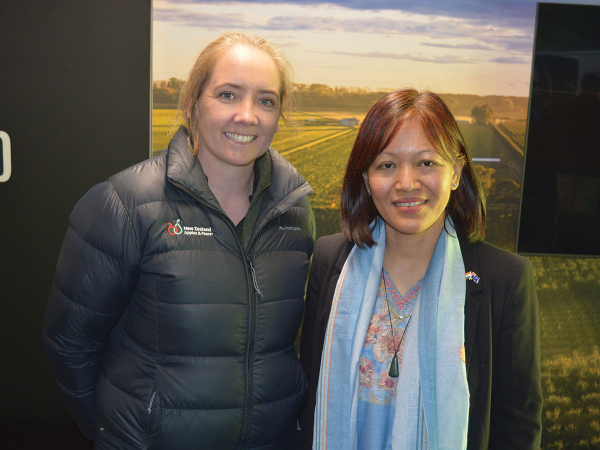 New Zealand Apples and Pears chief executive Danielle Adsett with Indian High Commissioner Muanpuii Saiawi at the Fieldays.
Eighteen months ago, when negotiations for a free trade deal with India were announced, New Zealand apple growers expressed their desire to be part of the deal.
But the Ministry for Foreign Affairs and Trade (MFAT) said "it was probably a no", according to New Zealand Apples and Pears chief executive Danielle Adsett.
She was told that apples won't be part of the deal because India has never done apples in any free trade deals before.
"Equally when we spoke to the Ministry of Agriculture and Farmers Welfare in Delhi, it was just a hard no," Adsett told a gathering at the National Fieldays in Hamilton.
"I don't take 'no' well and I thought there'll be a way around this.
"So, what we did is we decided to build on the decades of cooperation that we'd already had in that market."
New Zealand has been exporting apples to India since the early 1990s and has been part of several World Bank projects with NZ experts helping Indian apple growers lift productivity.
India, the fifth largest apple producing country in the world, has over 1 million apple growers, mainly in the northern states of Himachal Pradesh and Jammu and Kashmir.
Indian growers produce an average of six metric tonnes of apples per hectare, compared to NZ growers doing 120MT/ha. The Indian climate is extremely high. The cool chain is difficult, and the rootstocks and the varieties are very old.
Adsett says over the 18 months they went to MFAT with a co-operation plan - if NZ apples are included in the FTA, then they would send experts to India for five years post-FTA at their own cost to help Indian growers.
"So, we put that plan on the table and that also for us, it's about having complementary supply.
"India grows apples in the alternate season to New Zealand. So, we can provide apples into their market to complement their own domestic supply.
"And if we can help them prosper in their local communities, I think that will just go to show that this is more about the longer-term relationship between our apple growing nations than just what has happened as a result of the FTA."
When the Indian FTA was finalised late last year, New Zealand apples won a 50% reduction on tariffs, down to 25% for exports between 1 April and 31 August.
The quota starts at 32,500MT in year one, growing to 45,000MT in year six and onwards. Outside of these conditions, New Zealand growers can export at the current 50% tariff.
Adsett says getting apples on the table, that was cool.
"Those late night and early morning calls as we got through the nuts and bolts was great to be involved with and great to get there," she says.
"I think more importantly we're going to build the relationships that will see us prosper in this market into the future.
"And I think for us we see this as the start of the relationship, not the end."
The Indian FTA has come under fire from some NZ politicians, including New Zealand First leader Winston Peters.
But Agriculture and Trade Minister Todd McClay urges people not to "believe everything you hear blowing in the wind".
McClay says there's significant support throughout New Zealand for this free trade agreement because it is very high quality.
"And I know that Kiwis know that actually the relationship that we've formed with India, government-to-government, people-to-people, culture-to-culture, sport-to-sport, is actually good for us on both sides."
National’s much-touted free trade deal with India featured in the Rural Issues Debate at Mystery Creek, Hamilton on Wednesday night.

The apple sector is working with the Government to unlock access to two key markets that could bring millions in revenue for apple growers.
The avocado sector is entering the new season with a larger crop and positive market opportunities.
Just a matter of hours after Indian Prime Minister Narendra Modi's historic trip to New Zealand, the political doors in India swung wide open for Associate Minister of Agriculture, Mark Patterson, who was there to help promote our high-quality coarse wool.
A leading British farming politician says he's impressed with the positive attitude of New Zealand farmers that he met during his recent trip here.


When Northland leather worker Vernon Suckling started making horse saddles 50 years ago, quad bikes and side-by-side vehicles were unheard of.
Alliance Group has confirmed that eligible farmer-shareholders who supply and continue to back the business will receive up to $20 million later this year, following the strategic investment partnership with Dawn Meats.
With a general election under five weeks away, Rural News is asking major political parties about their policies and positions on key issues facing the primary sector. We will run their responses to each question over the next four weeks. The ACT Party and the Greens didn't respond in time.
The red meat sector is in great heart.
Dr Scott Champion, Foundation for Arable Research chief executive, says that everyone in the supply chain had a role to play in driving the sector's long-term success.
Entries opened on Monday, 5 October 2026 for the 2027 New Zealand Dairy Industry Awards (NZDIA), which organisers describe as the nation's biggest celebration of excellence in the dairy sector.