Fonterra FY26 Results: $9.69 Milk Price, $3.4bn Profit
Fonterra has unveiled its annual results for the 2026 financial year, posting $27 billion in revenue and close to $20 billion returned to New Zealand farmer owners and unit holders.
 increase font size
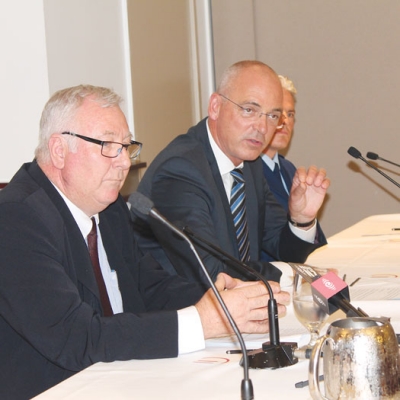 Tatua’s Paul McGilvary (right) and Fonterra’s Theo Spierings address media.
Fonterra chief executive Theo Spierings says other multi-nationals have dealt with issues such as the 1080 threat so they are being kept informed not only for transparency but for best practice around the globe.
Tatua chief executive Paul McGilvary, who attended an Auckland media briefing with Spierings, says these types of activities happen globally.
“There have been a number of them previously and our customers are well aware it can happen. The feedback I have had is that they want to work with us and help in any way to catch the perpetrator.”
Spierings says the threats have targeted the dairy industry as part of the investigation. He says it did not go public because it was a criminal act against New Zealand, so it was in the hands of the Government, there was a police investigation and it took time to secure the supply chain.
One reason for going public was to ask for the public’s help to find the perpetrators because that was the “best possible outcome”.
McGilvary said it was important to understand the dairy industry had done nothing wrong and they were dealing with criminal acts. “We have to respond to that with the Government and the police. The police are running the investigation and we need to work with that and allow time for that to run; we don’t want to do anything that prejudices that.
“We need to find this person; that is the first priority. We as an industry have worked very hard to lock down the supply chain. We need to find this person and lock our supply chain down to be absolutely sure the contaminant is not in it, that it can’t get into it.”
McGilvary said retailers were making strong efforts to control products at the point of sale so they cannot be contaminated in a supermarket. Although Tatua does not make either infant formula or nutritional powders, the threat was an industry-wide issue and all companies in the industry had lifted measures to secure the supply chain.
Spierings said the supply line was safe and secure because of such threats. They already have world class supply chains into markets. “For this we have stepped up measures to best-in-class in the world so we are absolutely certain about food safety and quality for our consumers.”
McGilvary said they would maintain this level of security until they find this person. “Some of the things are good practice anyway, we are constantly evolving and improving things… and that continues.”
McGilvary says the number-one driver of every action they take is safety of children in New Zealand overseas. “We are also very conscious of the safety of our employees and the provider community as well. We are assuring mums our products are safe and we will make sure they are safe when they buy them.”
McGilvary believes supply chains are locked down. “We also believe the police will find this person. It clearly takes time for the police to do what they have to do [including] decisions about timeframes and the best prospects for catching this person or persons. We’ve been using the time to lock down and make sure we don’t have any kind of risk to our supply chains.”
Spierings said it was far too early to focus on the financial impact; the focus was the criminal act and safety of consumers.
McGilvary says protecting people is the highest priority but they also have to keep markets open, keep doing business and maintain strong customer relationships.
“So by locking down supply chains and assuring people of the safety of the products we’re making we think that goes a long way to mitigating financial risk.”
More about 1080
What is it?
Sodium fluoroacetate is a poison mixed into baits and used to kill pests such as possums, rats and stoats.
Why is it used in New Zealand?
To help control the spread of bovine tuberculosis, a disease carried by possums which can infect cattle and deer herds. 1080 poison is delivered in carrot, cereal, paste and gel baits. It is especially valuable for eradicating possums because it is the only poison available for aerial spreading over large areas of inaccessible country. Possums, an introduced species, are the main threat to many native plants and animals.
What effect does 1080 have on the environment?
Compound 1080 is fast acting and biodegradable. The toxin is readily dissolved and diluted by water, and is completely degraded by micro-organisms, so long-term environmental contamination is unlikely.
Is 1080 harmful to people?
No effects on human health have been demonstrated from environmental exposure. Workers in the pest control industry are at greatest risk from unwanted exposure or poisoning, hence a lot of care is taken in the manufacture and use of 1080 baits.
What about other animals?
Dogs scavenging poisoned carcases are at greatest risk.
Why do people oppose it?
Opponents believe 1080 is inhumane and causes other animals, e.g. dogs, deer, birds, and fish, to suffer before dying.
Why do people support its use?
Scientists, farmers and conservationists are mostly united in the view that for now 1080 is the best solution we have, and until such time as an effective alternative is found it must remain a key component of New Zealand’s pest eradication strategy.
Fonterra has unveiled its annual results for the 2026 financial year, posting $27 billion in revenue and close to $20 billion returned to New Zealand farmer owners and unit holders.
Fonterra Co-operative Group has confirmed the independently assessed candidates standing for election to its board in 2026.
Fonterra has revised its Farmgate Milk Price forecast for the 2026/27 season, lifting the midpoint and narrowing the range on the back of improving global dairy commodity prices.
Outgoing Fonterra Co-operative Council chair John Stevenson says that it has been a privilege to represent the co-op's farmer shareholders.
OPINION: It seems Canterbury processor Synlait is still in the doldrums.



Federated Farmers says it welcomes Labour's commitment to reviewing the Sharemilking Agreements Act, calling on other major parties to do the same.
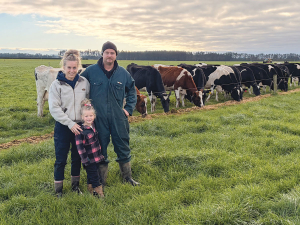
For Canterbury dairy farmers Sian Meijer and Rick Wobben, wearable technology has become one of their most valuable on-farm tools - helping manage 1850 cows across an expansive, high-performing dairy operation while improving efficiency, mating outcomes and day-to-day decision making.
Fonterra has unveiled its annual results for the 2026 financial year, posting $27 billion in revenue and close to $20 billion returned to New Zealand farmer owners and unit holders.
The first major update to the Dairy Cattle Code of Welfare in more than a decade has been released, marking what DairyNZ describes as an important step in ensuring animal welfare standards continue to evolve alongside scientific evidence and on-farm realities.
Ravensdown shareholders have elected Jane Montgomery and Kate Acland to the Ravensdown Board for three-year terms, following a closely contested director election.
Federated Farmers says new legislation replacing the Resource Management Act will cut red tape, unlock investment and help grow New Zealand's export-led economy, after the Planning Bill and Natural Environment Bill passed their third reading in Parliament yesterday.