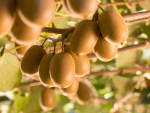
NZKGI Responds to Migrant Worker Exploitation Reports
Where any worker in the kiwifruit industry is mistreated, we expect the authorities to take action.
 increase font size

ABOVE AVERAGE production and prices bode well for pastoral agriculture in 2011/12, says MAF on releasing its half year update of its annual Situation and Outlook for New Zealand Agriculture and Forestry (SONZAF) report.
But medium-term the Ministry’s forecast is less positive as lower price forecasts start to bite, and for kiwifruit, which has a section to itself in the report, best and worst case scenarios are presented.
The update says this pastoral year got off to a good start with a generally favourable spring and plenty of feed.
Prices have generally held at historically high levels during the past half-year, despite the deteriorating global economy and high exchange rates.
Emerging markets for food and other primary products continue to grow, but the outlook is for weaker growth in many advanced economies such as the European Union.
This will take some of the shine off, says Alan Hook, MAF Manager of Sector Innovation, but prices are still mostly well above long-term averages.
Dairy to May 2012 is tipped to average $6.36/kgMS in the report, which was produced prior to Fonterra’s latest forecast increase of 20c/kgMS. In 2013 MAF predicts $6.25/kgMS.
Lamb (average of all grades) if forecast to come off a high of $6.23/kg cwt in 2011 to $6.08/kg in 2012 and $5.16/kg in 2013. Beef similarly slumps from $4.08/kg in 2011, to $4.01 in 2012 and $3.71/kg in 2013.
MAF’s forecast are based on a Treasury assumption current high exchange rates will persist for the next two years.
In dairy, MAF predicts a squeeze between increased supply from other major exporting countries and slowing demand from major importers such as China. However, increased production, driven by cow and in-calf heifer numbers climbing to 4.8m in 2012 and 4.93m in 2013, sees sector export revenues forecast up from $13.2b in 2011, to $13.6bn in 2012 and $13.7b in 2013.
Similarly combined export revenue from meat, wool and pelt forecast up in 2012 at $7.43bn before easing to $6.71bn in 2013. The 2013 figure is despite continued increases in production.
MAF says a weaker global economy will slow wool demand and moderate pricing in the next two years.
In kiwifruit, Psa’s impact is expected to cause an overall (green and gold) export volume drop of 21% to 89 million trays, reducing export returns 18% to $862 million, for the year ending 31 March 2013, from $1047m in 2012.
Given the uncertainty of Psa’s impact a “best case” export return of $915m, and worst case of $782m in 2013 are also presented.
Where any worker in the kiwifruit industry is mistreated, we expect the authorities to take action.

Kiwifruit growers are watchful but remain optimistic as concerns around the potential effects of the El Niño weather pattern this season.
More signs of a booming kiwifruit sector.
After delivering a strong financial year, rural trader PGG Wrightson says the coming months will depend on customer confidence and weather.
New Zealand growers have always adapted to changing conditions, but one challenge is steadily gaining ground across the horticulture sector: resistance.


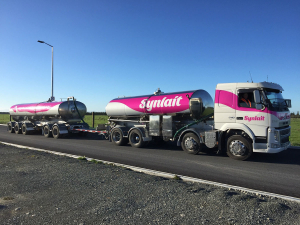
Synlait has swung to second-half profit as operations stabilise, but the dairy processor still posted a $75.4m annual loss.

LIC shareholders have elected a new North Island representative to the co-operative's Board, along with five representatives to its Shareholder Reference Group (SRG), following the company's Annual Meeting held in Invercargill.
Farmers across parts of Southland and South Otago are continuing to deal with difficult conditions after a prolonged run of wet weather, with pressure building around feed supply, stock management, pasture damage, farm infrastructure and everyday workloads.
Federated Farmers says it welcomes Labour's commitment to reviewing the Sharemilking Agreements Act, calling on other major parties to do the same.
For Canterbury dairy farmers Sian Meijer and Rick Wobben, wearable technology has become one of their most valuable on-farm tools - helping manage 1850 cows across an expansive, high-performing dairy operation while improving efficiency, mating outcomes and day-to-day decision making.
Fonterra has unveiled its annual results for the 2026 financial year, posting $27 billion in revenue and close to $20 billion returned to New Zealand farmer owners and unit holders.



