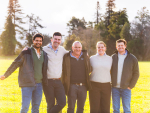
A REPORT produced by Gordon Stephenson trophy-winners Craige and Roz Mackenzie gives a fascinating insight into South American agriculture, says Simon Saunders, acting chair of the NZ Farm Environment (NZFE) Trust.
In April this year the National Winners of the 2013 Ballance Farm Environment Awards travelled to Argentina, Chile and Uruguay to study arable farming, dairying and beef production.
Facilitated by NZFE Trust, the 28-day tour was the official offshore component of Craige and Roz's role as ambassadors for the Ballance Farm Environment Awards.
The primary focus of their trip was to promote New Zealand's position as a leader of sustainable farming techniques and to gain "an understanding of South American farming systems and the impact new farming technologies are having nationally and within the farm gate".
The Canterbury farmers also examined the use of Genetically Modified (GM) plants within South American farming environments and the possible implications of GM for New Zealand.
Entitled 'What New Zealand Can Learn From Primary Production In Chile, Uruguay and Argentina,' their report is now available on NZFE Trust's website www.bfea.org.nz
Saunders says the comprehensive report is worthwhile reading for anyone interested in South American farming and the lessons and opportunities it offers the New Zealand agricultural sector.
The report gives excellent examples of how New Zealand technology and know-how is helping South American farmers to improve production.
"It provides a good reminder that for New Zealand to stay at the top, we need to keep investing in research and development. Craige and Roz's report also highlights the vital role that precision agriculture and genetic technologies are going to play in driving better sustainable outcomes in our farming systems."
Saunders says the report describes how poor infrastructure, especially roading, hinders agricultural production in South America.
"There is another big lesson for New Zealand here. If we are going to keep our primary sector strong, we must keep investing in infrastructure, especially in the regions."
The report says New Zealand is recognised in South America as a trusted producer of safe primary products that are grown in an environmentally and economically sustainable manner.
"We are envied for our access to innovative technology and research, for our innovative efforts in maintaining our unique biosecurity advantages, for our awareness nationally of the value that agriculture affords our country and for our willingness to engage openly with people internationally in ways which benefit all."