NZKGI Responds to Migrant Worker Exploitation Reports
Where any worker in the kiwifruit industry is mistreated, we expect the authorities to take action.
 increase font size
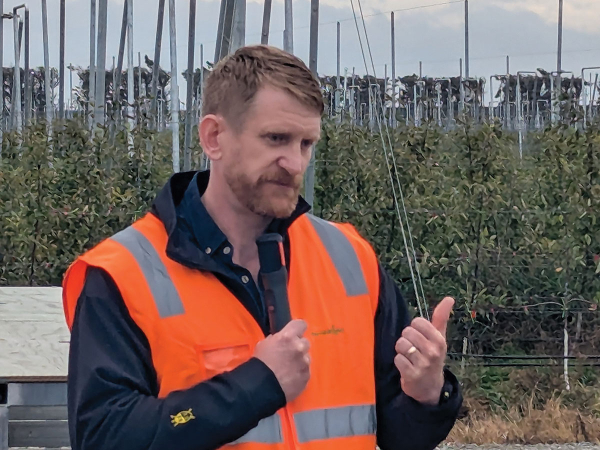 The general manager of FarmRight’s NZSF rural portfolio Ed Tapp speaks to visitors to the new Torea Orchard in Mid-Canterbury.
A large-scale modern orchard development in coastal Mid-Canterbury is expected to eventually produce 116 million apples a year from 900,000 trees while also becoming a significant employer for the region.
The Tōrea Orchard is fully New Zealand owned through the NZ Superannuation Fund, and managed by the New Zealand owned company FarmRight, which manages NZSF’s horticulture and dairy assets.
In a reversal of the trend towards further dairy conversions in Canterbury, the orchard is being established on what was a 1200-cow dairy farm at Pendarves, south of Rakaia. It was featured at Dairy NZ’s recent South Island Dairy Event (SIDE), with a field trip visit to the site.
Within a total area of 460ha, 125ha is initially being planted in Rockit apples and 125ha in Joli, both licenced varieties with strong export appeal and both judged as suitable for the climate and latitude of mid-Canterbury. The first commercial crop is expected in 2028.
The general manager of FarmRight’s Super Fund rural portfolio, Ed Tapp, said it handles roughly a billion dollars’ worth of Super Fund assets spread from Tauranga to Southland, about half dairy and half horticulture – apples, kiwifruit, grapes and hops.
When Tōrea is completed, they will have 530ha in apples, the rest mostly in Nelson and Hawkes Bay.
Tapp said they came to Canterbury about two and a half years ago looking to diversify in both variety and location, and selected Rockit and Joli for their suitability for Canterbury.
“We ended up with this property, not because we wanted to go out and convert a dairy farm, but we wanted the best land to convert into an orchard.”
The property has good growing degree days, a lower frost risk due to its proximity to the sea less than a kilometre away, reliable groundwater, and quality soil.
“There is the advantage of being a dairy farm that we’ve been able to run it as a dairy farm over the time that we’ve owned it, which is coming up to two years.”
Including worker accommodation, the conversion cost is about $120 million.
A portion on the coastal side will be retained as a 600 cow dairy farm, which Tapp said will still be an economic unit.
Tapp said they were aiming to be in the top 5% of the country’s apple growers, by setting it up from the start with high value varieties, efficient infrastructure and other innovations.
Tapp said the big things for anyone wanting to set up are capital and access to varieties.
Rockit apples are licenced by Rockit Apple Ltd and Joli by T&G Global.
He revealed that the Rockit license was $100,000 a hectare, but said that the licensing capital was what allowed the Rockit company to go build and maintain the market.
“There’s no guarantee around price. The big thing that we need to do is produce the quality fruit that they can then sell.”
Minimising variability of production was important and Tōrea orchard’s hail canopy and the irrigation system would be major factors in achieving that.
Tapp said FarmRight grows only high value varieties in its orchards, with high expectations around colour, size and disease control.
“Disease control is a big thing for market access. We need to give them the best fruit for them to them to then sell, but then the pricing structure is we get a premium for that. So that’s where the growing structure comes in.”
Orchard manager
Matt Bentley said they chose a Vee trellis rather than the more common single vertical axis because it gives more linear metres per hectare.
With 18 fruiting wires in the row it could crop 100 tonnes per hectare at 2 kgs per linear metre. The Vee system was repeatable, scalable, easier to mechanize and simpler for training up staff.
Offering some “fun facts” around the sheer scale of the project, Bentley said there were 27,000 of the galvanised steel Vee assemblies installed in just the first 150 ha, and the wires will span 15 times the length of the South Island once they are in place across all 250 ha.
The lower trunk of each tree is painted white so the hares don’t eat them, said Bentley.
“And that’s equivalent of 3000 litres of paint, which is 8500 Mona Lisas.”
Bentley said the biggest risk to the orchard management was staff recruitment, with close to 200 people needed at last year’s peak.
“So it’s a big push for us, having to exhaust the local labour and then get help when we can.”
A 100 bed RSC accommodation building is under construction on site and they were looking to put another 100 beds in either Rakaia or Ashburton.
Bentley said hail was another risk but 5.5m high wires will be fitted with bungee-loaded “catch and release” hail nets designed to collect hailstones then release them safely between the rows when the weight gets up.
“It also helps with retaining more moisture. And stops a bit of sunburn damage and stuff in the peak of summer. So there’s quite a few other benefits to it.”
Irrigation will be from twin drip lines, harvesting from mobile platforms – avoiding ladders for safety – and spraying from a machine that drives under the hail canopy with a boom that extends across three rows at a time in the interests of fuel efficiency.
The trees are supplied by Waimea Nurseries and grown on a dwarfing rootstock. Kept healthy, a tree could last decades but if a fruiting variety goes out of vogue it can be cut off and another variety grafted on.
The conversion is also expected to cut the farm’s environmental impact, with modelled reductions of 81 percent in Carbon emissions, 82 percent in Nitrogen losses and 40 percent in irrigation water use.
Where any worker in the kiwifruit industry is mistreated, we expect the authorities to take action.

Kiwifruit growers are watchful but remain optimistic as concerns around the potential effects of the El Niño weather pattern this season.
James Blair, an agronomist for AS Wilcox and the Pukekohe regional champion, has won the 2026 Young Grower national title.
Claimed to be the first autonomous robot for New Zealand vegetables growers, the first Kilter AX-1 unit has arrived in the country.
After delivering a strong financial year, rural trader PGG Wrightson says the coming months will depend on customer confidence and weather.


LIC shareholders have elected a new North Island representative to the co-operative's Board, along with five representatives to its Shareholder Reference Group (SRG), following the company's Annual Meeting held in Invercargill.
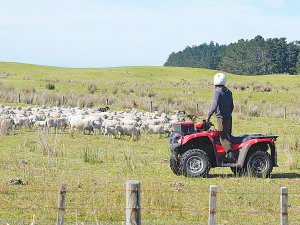
Farmers across parts of Southland and South Otago are continuing to deal with difficult conditions after a prolonged run of wet weather, with pressure building around feed supply, stock management, pasture damage, farm infrastructure and everyday workloads.
Federated Farmers says it welcomes Labour's commitment to reviewing the Sharemilking Agreements Act, calling on other major parties to do the same.
For Canterbury dairy farmers Sian Meijer and Rick Wobben, wearable technology has become one of their most valuable on-farm tools - helping manage 1850 cows across an expansive, high-performing dairy operation while improving efficiency, mating outcomes and day-to-day decision making.
Fonterra has unveiled its annual results for the 2026 financial year, posting $27 billion in revenue and close to $20 billion returned to New Zealand farmer owners and unit holders.
The first major update to the Dairy Cattle Code of Welfare in more than a decade has been released, marking what DairyNZ describes as an important step in ensuring animal welfare standards continue to evolve alongside scientific evidence and on-farm realities.



