NZ Ploughing Team to Use Borrowed Gear After Shipping Mix-Up
The New Zealand ploughing team to the world championship in Croatia next month will be banking on borrowed equipment as they seek glory.
 increase font size

A name synonymous with Ploughing in New Zealand is Alan Wallace, now of Te Awamutu, who was the first New Zealander to win a World Ploughing Championship held in Eire in 1981.
"When I stepped off the tractor I personally felt that I had given my best effort and as it turned out it was enough to win the World Championship," says Wallace.
He had already won four New Zealand Championships, which entitles the winner to represent New Zealand in the next World Championships. Formerly they competed in the same year but now it is in the year following to enable the winners to organise and make preparations.
Wallace, originally from Cambridge, started competitive ploughing in 1961 in events run by the Young Farmers Clubs. At that stage he had only done a little ploughing on the family farm.
He entered his first New Zealand Championships held at Invercargill in 1962 and has competed in 18 further events.
He won his first New Zealand Championship in 1968 which entitled him to plough at the world championships in Yugoslavia and the second in 1971 which enabled him to plough in the UK where he was second overall. His third win was in 1976 when he went onto plough in Sweden and his fourth win in 1980 which led to his World Championship win in Eire.
He retired from competitive ploughing following that victory and was a member of the New Zealand Ploughing Association Executive for 23 years. He has also judged at four world championships.
While all this was happening he was dairy farming at Cambridge till 1971, and then he and wife Tricia bought a farm at Te Awamutu growing maize and grazing cattle. They retired to town in 2002.
Wallace, following his retirement from competing, set himself the target of coaching another New Zealander to become a World Champion. He has coached six New Zealand champions and in 1971 coached Roger Jordan to runner up in the World Championships held in Australia.
Then in 2010 he coached Bruce Redmond to win the World Championship conventional ploughing at the world event held at Methven.
New Zealand has had one other world champion, Ian Miller, who won in 1982 ploughing in Australia.
Wallace has always been a conventional ploughman but has developed an interest in reversible ploughing and later this year will be coaching Malcolm Taylor (Rural News 510) at the world championships to be held in Croatia.
Rural News: What does a ploughing coach, coach?
Wallace: "A ploughing match is a very intense event and there are a lot of things to do and to think about and the aim is to improve every aspect so that a competitive ploughman can achieve maximum points."
Things such as advising on plough settings to soil types and conditions such as wet/dry soils which can often change from the practice days. He comments that a good coach must have the ability to stand back and perhaps see minor faults that a busy competitor cannot see.
Ploughing events are judged on 10 different aspects, the most important is straightness. Others include the split opening, body work, uniformity of furrows, headlands, the ins and outs and that nothing is left under ploughed or over ploughed. Furrow depth is set by the organisers.
"The aim is to get a complete burial of stubble or grass and to leave a good depth of soil to form a good seed bed."
The last factor is the overall appearance of the plot and Wallace says there are a lot of skills needed to complete a top finish.
He is a member of the Waikato Ploughing Association committee organising this year's New Zealand Championships to be held at Cambridge on April 14-15.
The New Zealand ploughing team to the world championship in Croatia next month will be banking on borrowed equipment as they seek glory.
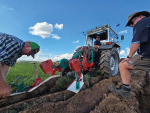
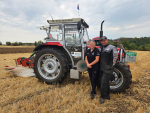
Ploughing champions Mark Dillon and Malcolm Taylor earned the right to represent the country at the World Ploughing Championships in Osijek, Croatia, on 5 and 6 September, after winning their titles at the New Zealand Ploughing Championships in Middlemarch in 2025.
Sean Leslie and Casey Tilson from Middlemarch, with horses Beau and Dough, took out the Rural News Horse Plough award at the Power Farming NZ Ploughing Championships at Horotiu, near Hamilton, on April 13-14.
The mood is relaxed as father and son ploughmen Paul and Derek Houghton get some practice in, but when the national championship starts this Saturday it will be a different story.
With our own National Fieldays only few weeks away, Rural News took the opportunity to take a trip overseas – as a guest of Enterprise Ireland, which invited 190 guests from 19 countries – to look at Ireland’s own national event, locally known as The Ploughing.


LIC shareholders have elected a new North Island representative to the co-operative's Board, along with five representatives to its Shareholder Reference Group (SRG), following the company's Annual Meeting held in Invercargill.
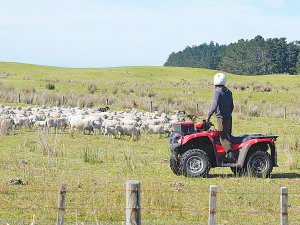
Farmers across parts of Southland and South Otago are continuing to deal with difficult conditions after a prolonged run of wet weather, with pressure building around feed supply, stock management, pasture damage, farm infrastructure and everyday workloads.
Federated Farmers says it welcomes Labour's commitment to reviewing the Sharemilking Agreements Act, calling on other major parties to do the same.
For Canterbury dairy farmers Sian Meijer and Rick Wobben, wearable technology has become one of their most valuable on-farm tools - helping manage 1850 cows across an expansive, high-performing dairy operation while improving efficiency, mating outcomes and day-to-day decision making.
Fonterra has unveiled its annual results for the 2026 financial year, posting $27 billion in revenue and close to $20 billion returned to New Zealand farmer owners and unit holders.
The first major update to the Dairy Cattle Code of Welfare in more than a decade has been released, marking what DairyNZ describes as an important step in ensuring animal welfare standards continue to evolve alongside scientific evidence and on-farm realities.