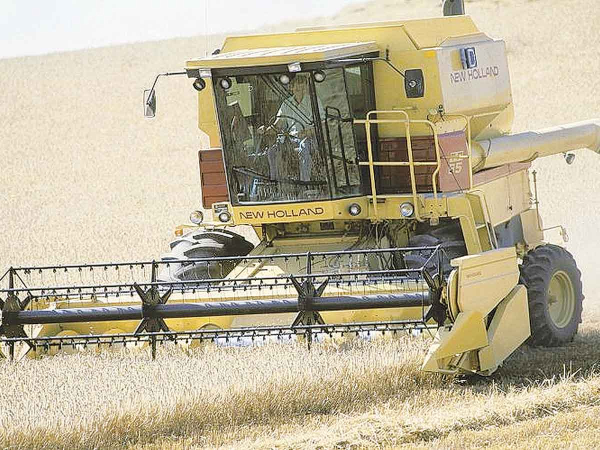
New Holland is celebrating the 50th anniversary of the introduction its Twin Rotor threshing and separation technology, which has evolved from a single model in 1975 to a range today, led by the new CR10 and CR11.
The manufacturer reports that over 70,000 TR and CR Twin Rotor combines have been produced globally to date. New Holland, largely US-based, entered the combine market in 1964 when it acquired Belgian company Claeys. Over the following decade, NH continued to develop the straw-walker combine line it had acquired, but in the 1960s, explored new ideas for threshing and separating to boost output, improve samples and reduce losses.
Focusing on using centrifugal forces, distinctly different from the drum/ concave and straw-walker method of threshing and separation, the first development was trialled in corn in 1968 and wheat the following year.
The trial machine split the incoming crop from the feeder housing into two streams, feeding two counter-rotating, longitudinal rotors working within longitudinal concaves that consisted of threshing sections followed by separation sections. The high rotor speeds ejected much of the grain through the concaves, minimising grain damage and losses when compared to drum/ concave threshing and straw-walker separation.
In 1975, the first USbuilt, NH combine, the TR 70 was launched, equipped with a 145hp engine and 5,550-litre grain tank, to be replaced in 1979 by the upgraded TR75, and joined by a larger brother, the TR85. Over the next 20 years the range evolved continuously, with the 25,000th TR unit produced in 1997.
Across the Atlantic, European high-capacity combine development took a separate path, the Twin-Flow combines introduced in 1983. These “hybrid” machines used a conventional drum and concave layout, followed by a large beater and rotary separator, then a lateral Twin Flow rotor that split the crop into two streams for final separation. By the late 1990s, New Holland engineers in Europe and North America began work on a totally new Twin Rotor design that would handle all types of crops. Introduced in 2002, blending key features from the TR and TF series, the new 333hp CR960 and 428hp CR980 were initially built in the USA, before being transferred to the Zedelgem plant in 2005 Belgium.
The CR960 and CR980 featured twin, 17-inch and 22-ich rotors respectively and introduced features including IntelliSense machine automation, Dynamic Flow Control remotely adjustable rotor vanes, Dynamic Feed Roll technology and Opti-Spread Plus residue management.
Elevation models arrived in 2007, introducing Intelli-Cruise feed rate control for maximum output, and Opti-Clean cleaning technology to further enhance grain samples, before evolving into the CR7.90, CR8.90, CR9.90 and CR10.90 models. The flagship machine took the Guinness World Record for the most wheat harvested in eight hours, at 797.656 tonnes in 2014.
Today the range is topped by the recently introduced CR11, with775hp/ 20,000-litre grain tank and CR10 at 634hp/16,000-litre grain tank models.