Krone XDisc 710 Now Fits John Deere, New Holland Foragers
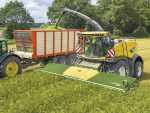
Krone's XDisc 710 direct-cut header can now be used by John Deere and New Holland forage harvesters, as well as the Krone Big X it was originally designed for.
 increase font size
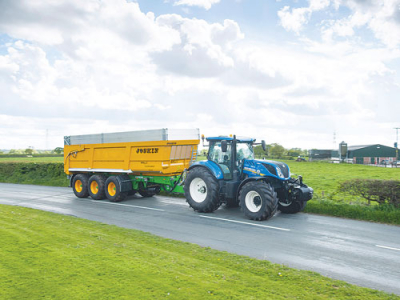 New Holland’s T7 Series has been updated.
New Holland Agriculture is updating the T7 long wheel base with a new suspended front axle designed to ease the operator’s life while driving at high speed.
A combination of new geometry, low friction hub bearings and a new hydraulic steering unit is said to deliver better feedback and control to the driver, and the self-centring characteristic designed into the axle reduces corrections at high speed, reducing operator fatigue.
In combination, the tractor’s front suspension has updates to improve performance over the wide variety of front axle loads encountered by a tractor.
A new control valve with dual accumulators helps deliver an 11% improvement over the existing design when measuring chassis vibration.
A concept known as ‘skyhook’ momentarily stiffens the suspension to keep the tractor level irrespective of external forces such as implements being raised or lowered, braking or accelerating, or weight transfer on and off the front axle. In practice, the upgraded T7 weighs the rear implement to determine how much stiffening is required to reduce excessive suspension travel at higher speeds.
Meanwhile, an accelerometer in the nose of the tractor monitors chassis movement on uneven surfaces and continually adjusts the suspension damping to improve stability, safety and comfort. Depending on operator preference the suspension can be operated in soft, normal or hard modes.
Also new for 2018, CustomSteer offers variable ratio steering on the T7 range. This allows the driver to vary the number of rotations of the steering wheel needed to turn the axle hubs from lock to lock.
Three selectable settings of 1:1, 2:1 or 3:1 rotations of the steering wheel can be chosen with the IntelliView IV that also offers a different ratio for forward than for reverse. Steering ratios can also be changed automatically within the headland turn program HTS II, e.g. one ratio for working, one for turning at the headland and one for reversing.
In operation, custom ratio is gradually dialled out as speed increases, up to 26km/h, and slowing the tractor causes CustomSteer to re-engage automatically.
T7 LWB has a higher gross vehicle weight (14,000kg) allowing higher payloads for customers.
An updated front instrument cluster, with white backlighting and blue needles refreshes the front console, and the IntelliView IV monitor uses new graphics to illustrate the selectable engine values chosen for the Auto Command transmission’s working limits.
For drivers looking to monitor operations, a camera-ready option allows connection of up to three camera feeds with images displayed on the IntelliView screen.
Krone's XDisc 710 direct-cut header can now be used by John Deere and New Holland forage harvesters, as well as the Krone Big X it was originally designed for.
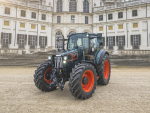
Creating a great deal of enthusiasm at Agritechnica, the T5.120 ‘Il Trattore’ styling concept tractor was celebrating the legacy of research and development, engineering, and design expertise, with the concept bearing a striking green and red colouring and styling inspired by the original first Fiat tractor, the Fiat 702 and the ‘Made in Italy’ logo.
First unveiled in 2023, New Holland has announced the addition of the T7.270 Methane Power CNG (Compressed Natural Gas) tractor to the recently expanded T7 Range.
A group of eight Giltrap Agrizone customers travelled to Europe in July with managing director Andrew Giltrap, taking the opportunity to visit St Valentin, Austria, to see New Holland tractors being built.
Showcased with a T7.245 at the recent National Fieldays, New Holland has expanded its T7 tractor range offering in New Zealand with the launch of a new Tier 3 long-wheelbase configuration, aimed at users looking for a reliable, no-fuss workhorse.



LIC shareholders have elected a new North Island representative to the co-operative's Board, along with five representatives to its Shareholder Reference Group (SRG), following the company's Annual Meeting held in Invercargill.
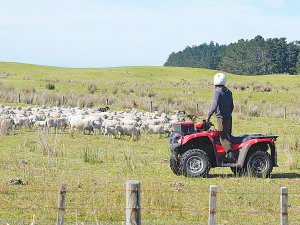
Farmers across parts of Southland and South Otago are continuing to deal with difficult conditions after a prolonged run of wet weather, with pressure building around feed supply, stock management, pasture damage, farm infrastructure and everyday workloads.
Federated Farmers says it welcomes Labour's commitment to reviewing the Sharemilking Agreements Act, calling on other major parties to do the same.
For Canterbury dairy farmers Sian Meijer and Rick Wobben, wearable technology has become one of their most valuable on-farm tools - helping manage 1850 cows across an expansive, high-performing dairy operation while improving efficiency, mating outcomes and day-to-day decision making.
Fonterra has unveiled its annual results for the 2026 financial year, posting $27 billion in revenue and close to $20 billion returned to New Zealand farmer owners and unit holders.
The first major update to the Dairy Cattle Code of Welfare in more than a decade has been released, marking what DairyNZ describes as an important step in ensuring animal welfare standards continue to evolve alongside scientific evidence and on-farm realities.