For ten years quads have been getting bigger and piling on cubic capacity: it’s no surprise now to see machines of 750, 800 or even 1000cc.
This size and power, pulling heavy loads, is probably the domain of a small tractor, but that’s another story.
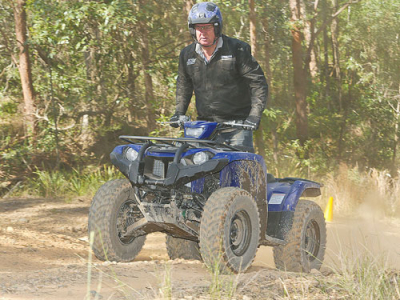
Yamaha has recently published details of its new Kodiak 450, which replaces the ageing Grizzly 450. Several design changes are intended to target the agricultural market that makes up 70% of purchasers.
The company line ‘work hard, ride easy’ draws on the four ‘Cs’ of the new machine – control, comfort, confidence and convenience.
Described as an entry-level machine, but still extremely capable, it proved its mettle in tough trails around the Cotton Hill region southwest of the city.
Structural changes to the Grizzly chassis include more space for the fitment of a new EFI engine, but more importantly include longer seat rails to allow more comfort for the operator.
Stability is improved by increasing the wheelbase and an increased track width, while longer gas shocks soak up the rough stuff.
The 421cc fuel injected engine delivers power smoothly from any throttle position and takes the machine quickly to its top speed of 80km/h. Rubber-mounting absorbs vibrations and promotes comfort over a long day, while the well-known Ultramatic CVT drive system benefits from all-wheel downhill braking, which inspired exceptional confidence in tricky sections during the test ride, particularly in the low-range mode.
Safe stopping is a prerequisite for an ATV and the Kodiak doesn’t disappoint there, with twin discs up front and a maintenance-free, integral disc brake pack ahead of the final drive taking care of things proficiently.
Test machines on the day were fitted with the optional, variable rate, electric power steering system that reduces effort and it was adept at pointing the machine in the intended direction.
Rural News sees this is a must-have for anyone planning to use this machine regularly.
Helping with rider comfort is a re-modelled seat, longer than the Grizzly’s and narrower in the nose; it helps promote active riding with smooth body movement.
Likewise the wider track allows longer and wider footwells, a real plus for riders living in gumboots during a typical NZ winter.
Controls fall easily to hand, with a redesigned thumb throttle control said to reduce fatigue, a gear selection lever pushed forwards and upwards on the left-hand fender and out of the way of the rider’s knees, and a 2WD/4WD push button system available on the fly.
Other standard equipment includes a full-length bash plate with access to all drain points, 12V power supply to power phones or pumps, and pre-wiring for owners looking to fit a winch front and rear; racks offer 40kg and 80kg capacities respectively. This combines with a towing capacity rated at 600kg to make the Kodiak a very useful machine.
Indeed, those four ‘Cs’ can probably be pushed out to a stellar six with the addition of ‘capable’ and ‘classic’. We eagerly await our extended test on NZ soil.