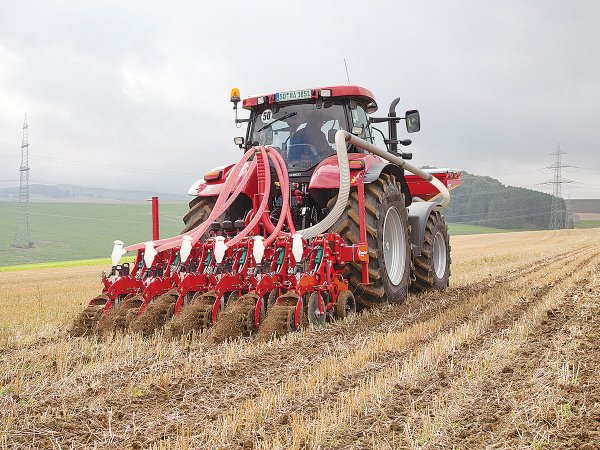
According to Kverneland distributor, Power Farming, the KultiStrip system will bring opportunities to farm environmentally, while improving yields and profitability.
It says the technically unique, one-pass cultivator-fertiliser machine - which encompasses a strip-till system to reduce cultivation costs - helps aid plant establishment, improves soil condition and ensures yield.
Strip tillage, used for more than 20 years in North America, is a method of preparing the soil for row crops such as maize, beet, sunflower, canola, sorghum, soya, vegetables and hybrid corn. Only distributing the soil where the crop will grow, the uncultivated soil between the strips and the layer of residue that remains helps to prevent erosion. This is said to increase both water absorption and retention in the soil, while creating a significant reduction in tillage costs.
Within the cultivated row, which only represents 30% of the field area, trash is removed leaving a fine seedbed offering ideal conditions for young plants to establish. When creating the seedbed, fertiliser can also be placed near plants for best utilisation.
With less of the paddock being cultivated, there is more chance of completing work during poor weather conditions and/or planting earlier in the season to help bring harvest dates forward.
Looking at the machine in more detail, the rigid 3000, 4500 and 6000 models have working widths of 3,4.5 and 6 metres and feature a heavy-duty mainframe. Alternatively, the 4500F and 6000F models have hydraulically folding frames, which bring the units down to 3m wide and 4m high to meet transport vehicles.
Both the rigid and folding designs of the KultiStrip can be fitted with an even or uneven number of rows, with a row width of 45-80cm. The 3cm unit can be configured with up to six rows, the 4.5m up to 10, and the 6m unit up to 13 rows.
Up front, 520mm cutting discs slice through crop residues and open the soil to a pre-set depth before adjustable trash wheels is remove any plant residues from the cultivated strip. Next, tines work to a maximum depth of 30cm, while an adjustable strip limitation disc determines the width and shape of the cultivated strip - which helps keep loose soil within the 'worked' strip. Finally, a press wheel consolidates the soil using a rubber Farm Flex wheel or optional cage roller or V-press wheels fro varying soil types.
Fertiliser is placed in the lower levels of the profile by the fertiliser coulter, allowing the soil to be worked in a single pass. Alternatively, the KultiStrip machine can be used in conjunction with an effluent tanker to place liquid fertilisers in the soil profile at a pre-determined depth.
Given the increasing awareness of the need to improve the quality New Zealand's waterways, and the implementation of specific regional schemes, the KultiStrip should offer growers and contractors a tool that can help limit erosion - particularly on sloping ground, which should keep the regulators happy!