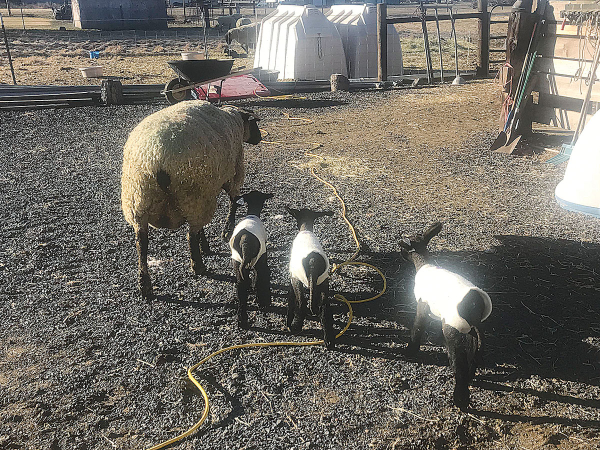
A Christchurch manufacturer of woollen covers for newborn lambs says his covers pay dividends in survival rates and liveweight gains, especially at a time when farmers are feeling the economic pinch.
David Brown has been marketing his Woolover brand covers for 30 years, producing a range of covers sized for lambs, dairy calves or beef calves.
The former South Canterbury farmer contracts out the weaving, cutting out and assembling of the products to various Christchurch firms. He says his lamb covers, made of 100% New Zealand wool, have the maximum number of fibres per square metre to deliver the maximum warmth and available stretch to accommodate the first three weeks expected growth of a newborn lamb.
Brown says farmers can expect two-thirds of a kg extra weight gain in the first three weeks for a lamb wearing a Woolover cover, compared to a lamb that isn't, particularly in cold wet windy weather.
At $6 each cover and the schedule at $5/kg liveweight, Brown says the extra weight alone goes a long way to paying for the covers, "plus the satisfaction of reducing the risk of lambs dying from hypothermia".
He bases the weight gain expectation on a trial he carried out with his son several years ago, when they took lamb covers to a number of farms between Oxford and Rakaia, and put covers on 1800 sets of twins - coverig one twin and leaving the other, and weighing the lambs before and after to see what difference the covers made.
"We got two thirds of a kilogram in 16 days. And the weather was abnormally fine. It wasn't particularly cold."
Brown does not say all lambs should be covered but suggest a minimum of 10% of the flock.
"Three thousand ewes will need 300 Woolover lamb covers. This is because storms always arrive at peak lambing time, and twins and triplets are the most at risk.
"Three hundred Woolovers at $6.00 will cost $1,800 so you need to save just 18 lambs to cover your investment."
Brown admits that fitting the covers requires some work, and with the rise of some easy-care breeds, "not every farmer wants to shepherd".
Those who do, reap the rewards, he says.
Brown says that where people "are really making some money" is with weather forecasting getting much more accurate. At lunchtime a farmer might hear a forecast of a Southerly coming through at four o'clock, when he knows he has say, 10 sets of newborn twins in the paddock.
"Go our and cover those 10 sets of twins because those are the ones you'll be thinking about at 10 o'clock tonight. Be proactive not reactive. At least you will know at 10 o'clock tonight that they're not going to go down."