Editorial: Common Sense Prevails
OPINION: The Government's decision to reinstate agriculture and horticultural science as a standalone subject from Year 11 is the right one.




 increase font size
Federated Farmers has called on Central Otago District Council (CODC) to drop or vote down a plan to truck sludge from Alexandra and Cromwell to farmland near Lauder, warning it would compound an "outrageous" situation created by a separate council's decision weeks earlier.
CODC will decide at a meeting this week whether to send thousands of cubic metres of accumulated sludge to the Manuherekia catchment. Council staff have recommended the option, saying it could save ratepayers about $600,000 compared with trucking the waste to a landfill in Winton.
Federated Farmers Otago president Anna Gillespie said the proposal follows closely on the heels of a non-notified consent granted to Queenstown Lakes District Council to spread Wānaka and Albert Town's sludge on a former sheep and beef farm in Lauder.
"It's absolutely staggering that the council is even discussing this after the recent outcry over Wānaka trucking its treated excrement to a Lauder farm," Gillespie said.
According to the council report, sludge from the Cromwell treatment plant has been stored in geobags — porous containers that let the material dry out before transport.
The council says it is running out of storage space, and a further 20,000 cubic metres of sludge from wastewater settlement ponds needs to be shifted urgently or the plant risks breaching its own consent.
Sludge from the Alexandra plant also needs a destination.
Gillespie said the Manuherekia catchment has been the focus of years of work by local farmers to improve water quality, backed by more than $4 million in central government Jobs for Nature funding through the Thomson's catchment project and Waiora Manuherekia.
She questioned modelling used to support the Lauder consent, arguing the farm's gravelly, low-rainfall soils cannot realistically grow enough crops to absorb the nutrients in the volume of sludge proposed.
"There is a serious mismatch between those estimations and what the consent allows," she said.
The Wānaka-related consent, granted without a public hearing on the basis its effects would be "no more than minor," allows up to 2000 cubic metres of sewage sludge and a further 3600 cubic metres of grease trap, mud tank and winery wastewater to be spread across 178 hectares at Lauder.
The same consent permits CODC to use it too, via contractor SJ Allen Ltd.
Gillespie said the group wants the existing Lauder consent re-investigated and is renewing its call for Local Government Minister Simon Watts to intervene.
"We're calling on Central Otago District councillors to kick this short-sighted plan to touch," she said.
OPINION: The Government's decision to reinstate agriculture and horticultural science as a standalone subject from Year 11 is the right one.
With less than a week to go before voters choose the next government, Federated Farmers has a simple message to its members - get out and vote.
Federated Farmers has welcomed new rural policies released by ACT, saying they align closely with its own election priorities.
A farmgate milk price of $10/kgMS this season is firming up as milk powder prices soar and the New Zealand dollar weakens.
Federated Farmers is backing Feilding High School’s call to keep Agriculture and Horticultural Science as a standalone subject in Year 11.



Three men have been sentenced in District Courts after Ministry for Primary Industries prosecutions over animal welfare, food safety and cattle tracing offences.
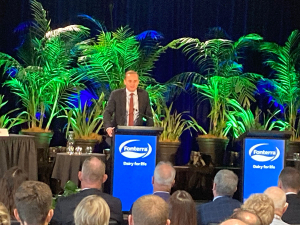
Fonterra’s 2026 financial year was a year of delivery, with record volumes of milk collected, processed and shipped by the co-op.
OPINION: The Government's decision to reinstate agriculture and horticultural science as a standalone subject from Year 11 is the right one.
Dairy farmers, still holding onto their Fonterra shares despite switching milk supply elsewhere or exiting the industry, now face a stricter share sell-down requirement.
Hamilton-based agritech company Aimer Farming has completed a $3 million capital raise to support its next stage of growth, including a beef farming product due to launch in 2027.
When dairy manager Miriam Lauridsen learned the farm, she was joining held weekly health and safety meetings, she initially thought that was “a bit over the top”. Experiencing that culture changed her mind.




OPINION: The same mainstream media muppets that brought you Jacindamania in 2017 have been flat out pimping for the Opportunities…
OPINION: Your old mate reckons the atrocious way farmers in the UK are treated by their lords and masters in…