Ravensdown Elects Montgomery, Acland to Board
Ravensdown shareholders have elected Jane Montgomery and Kate Acland to the Ravensdown Board for three-year terms, following a closely contested director election.
 increase font size
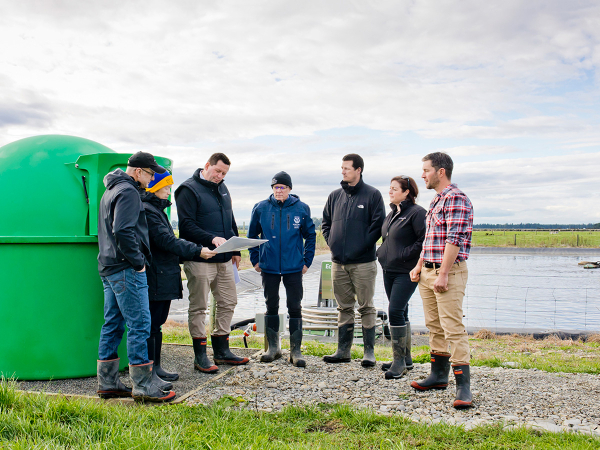 L-R: Stuart Taylor (General Manager Farming, Craigmore), Professor Hong Di (Lincoln University), Carl Ahlfeld (Product Manager ClearTech & EcoPond, Agnition), Emeritus Professor Keith Cameron (Lincoln University), Elliot Mercer (General Manager Innovation, Agnition), Nikki Cameron (Operations Manager, Craigmore), Steven Melville (Business Manager, Glen Eyre Farm, Craigmore)
Craigmore Sustainables is trialling new technology designed to reduce methane in effluent ponds, something the company claims is a first for the New Zealand dairy industry.
The company’s 400ha dairy farm Glen Eyre in Oxford, North Canterbury will adopt EcoPond, an effluent treatment system that removes almost all methane emitted from effluent ponds with an additive normally used in the treatment of drinking water.
The technology is the result of a collaboration between Ravensdown and Lincoln University.
Craigmore’s general manager of farming, Stuart Taylor says the company is striving to be a leader in the trial and adoption of new technology.
“Craigmore recognises that farming plays an important role in both contributing to and mitigating climate change and we have an ambition to materially exceed the targets set by the Climate Change Commission through land use change and changes to existing operations,” says Taylor.
He says the EcoPond technology could play a key role in supporting farmers to reduce methane and help New Zealand meet its climate change targets.
“EcoPond is an important trial for us because we are keen to apply innovative ways to the reduction of emissions and minimise environmental impacts.”
Iron sulphate treatment is highly effective in reducing methane emissions due to increased microbial competition for organic matter substrate due to the addition of sulphate and ferric ions.
This restricts the growth of the methane-producing microorganisms known as methanogens.
Initial tests undertaken in May tested the effluent from the effluent pond after it had been treated with iron sulphate through EcoPond. This showed a 95% reduction in CH4 (methane) which is highly significant.
Taylor says the technology is an example of the primary sector leading the world in reducing emissions and playing its part in addressing climate change.
“We have several sustainability programmes in place to ensure we strike a balance between respecting the environment and running a sustainable and profitable rural operation,” he says.
Earlier this year, EcoPond became part of the newly established Ravensdown entity, Agnition. Agnition’s mission is to get innovations on farm faster.
Agnition chief executive Jasper van Halder says EcoPond is an important part of the entity’s arsenal of technology and innovations, something he says will help quickly deliver practical and sustainable on-farm solutions for New Zealand farmers and growers.
“It’s great to see Craigmore take a leadership role and demonstrate what can be achieved with EcoPond technology,” he says.
“Partnerships and innovation are required in the sector. It’s hard to beat practical on-farm use to really demonstrate the EcoPond advantage and partners like Craigmore show us the future of farming.”
Ravensdown shareholders have elected Jane Montgomery and Kate Acland to the Ravensdown Board for three-year terms, following a closely contested director election.

OPINION: It appears to be difficult for people who haven’t tried to run a business to understand the difference between assets and cash.
OPINION: In the 1980s, concern was expressed in West Germany about the falling birth rate. Some simple analysis was performed by Professor Helmut Sies, physician and biochemist at Dusseldorf University. His letter ‘A new parameter for sex education’ was published in Nature in 1988:
When it comes to annual rebates, it's been a long time between drinks for Ravensdown shareholders.
Ravensdown has reported a net profit before tax and rebate of $50.1 million for the year ended 31 May 2026.



Federated Farmers has welcomed new rural policies released by ACT, saying they align closely with its own election priorities.

Rural Contractors NZ says proposed changes to land transport rules for agricultural vehicles are a welcome response by the Government to out of date regulations which have seen members hit with huge fines.
Alliance is calling for final applications for its 2027 Graduate Programme, with applications closing on Sunday 25 October.
Decades piloting planes has ensured vet and farmer David Hayes is focused on safety. So, after a serious accident while welding on farm, he is sharing his experience so others can learn from it.
Canterbury milk processor, Synlait Milk has confirmed Leon Fung as its chief executive officer.
OPINION: Making it easier to collect rainwater and use it to grow crops and livestock is a no brainer.