B+LNZ Urges Farmers to Graze Lucerne Hard Before Winter Weed Control
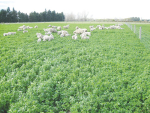
Beef + Lamb New Zealand is reminding farmers with lucerne stands to graze them hard over the next few weeks in preparation for a winter weed control programme.
 increase font size
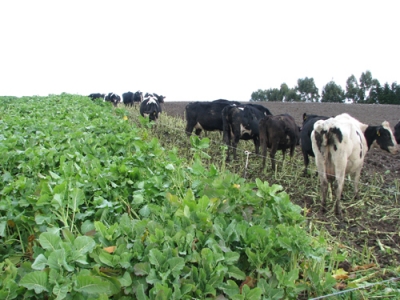
Cropping farmers are being urged to consider the true cost of winter grazing to their businesses.
During a series of grower workshops in recent weeks the Foundation for Arable Research (FAR) has outlined best practice and highlighted potential pitfalls.
“We’re looking at the whole farm system and brassica and fodder beet are an increasingly important part of what cropping farms are doing,” FAR’s Ivan Lawrie told one of the workshops.
Even in 2009, 30% of arable farms were growing such forage crops for dairy grazing or finishing beef or lambs on, and that percentage “has grown substantially in the last five years,” he says.
“Traditionally this wasn’t our space but we felt it was falling between the cracks…. There wasn’t any integration between the three levy organisations getting information on these crops out to everybody.”
Now, partly with Government funding, the organisation is working with other sector bodies to develop best practice guidelines and put numbers on the impact of various winter grazing techniques on subsequent crops. “That’s not been easy to do,” notes Lawrie’s colleague Diane Mathers.
Initial work has identified some evidence of compaction in winter grazed areas compared to non-grazed. Soil bulk-density tests taken pre- and post-grazing towards the end of winter on seven farms by FAR found a range of 1.08 to 1.36 before grazing to 1.15 to 1.48 after, where untouched soil would be 1.0 and severely compacted 1.4.
“You can rip the soil but it’s not going to fix that [bulk density] problem overnight,” says Lawrie.
Mathers says the wet-weather compaction reduces soil aggregate stability, impairing rooting and increasing risk of run-off and erosion. “Obviously if we’re going to wreck our soils we’ve got a bit of an issue.”
Some farms have reported yield impacts on following crops as much as three years after a severe winter grazing event, but there’s been no scientific study to establish how severe or how widespread such incidences are. “Perhaps that’s one of the areas we need to put work into,” adds Mathers.
Faster results of soil mineral nitrogen tests following grazing would also help growers account for residual fertility when applying fertiliser to following crops, she notes.
“You get denitrification in cold wet soils so there may not be as much there as you think. And heaven help us if we ever get back into talking about emissions because that’s another loss farmers will get hammered with.”
Losses through drainage may also be considerable: Mathers noted that at one workshop an Environment Canterbury representative said about half the nitrogen lost on arable farms comes from “that little bit of dairy grazing”.
Managing winter grazing risk
Beef + Lamb New Zealand is reminding farmers with lucerne stands to graze them hard over the next few weeks in preparation for a winter weed control programme.
Southland farmers are being encouraged to get ahead of the winter grazing season by attending a practical field day in Pukerau next week.
Farmers wanting to establish subterranean clovers in their pastures this autumn are encouraged by Beef + Lamb NZ to graze pastures down to 700-1000 kg DM/ha prior to sowing.
Animal welfare is of paramount importance to New Zealand's dairy industry, with consumers increasingly interested in how food is produced, not just the quality of the final product.
Recent widespread autumn rain will have triggered the germination of subterranean clover seeds, and the resulting seedlings should be allowed to reach the 3–4 trifoliate leaf stage before grazing, says Beef+Lamb NZ.


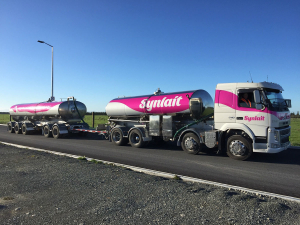
Synlait has swung to second-half profit as operations stabilise, but the dairy processor still posted a $75.4m annual loss.

LIC shareholders have elected a new North Island representative to the co-operative's Board, along with five representatives to its Shareholder Reference Group (SRG), following the company's Annual Meeting held in Invercargill.
Farmers across parts of Southland and South Otago are continuing to deal with difficult conditions after a prolonged run of wet weather, with pressure building around feed supply, stock management, pasture damage, farm infrastructure and everyday workloads.
Federated Farmers says it welcomes Labour's commitment to reviewing the Sharemilking Agreements Act, calling on other major parties to do the same.
For Canterbury dairy farmers Sian Meijer and Rick Wobben, wearable technology has become one of their most valuable on-farm tools - helping manage 1850 cows across an expansive, high-performing dairy operation while improving efficiency, mating outcomes and day-to-day decision making.
Fonterra has unveiled its annual results for the 2026 financial year, posting $27 billion in revenue and close to $20 billion returned to New Zealand farmer owners and unit holders.