Evaluating Tech Providers Beyond The Product
As the dust settles after Fieldays, we're once again reminded of the sheer volume of technology now available to New Zealand dairy farmers.




 increase font size
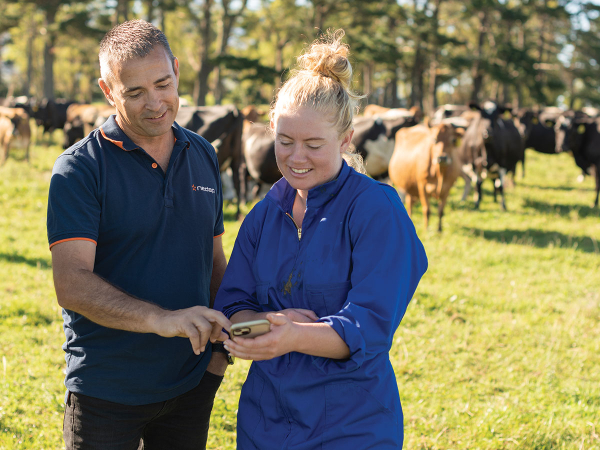 Nedap General Manager Oceania, Greg Hamill on farm in Taranaki with farmer Elly Grahame.
Technology adoption on New Zealand dairy farms has accelerated rapidly over the past decade.
What was once considered ‘nice to have’ is increasingly becoming essential as farmers navigate labour shortages, tighter margins, environmental pressure and the need to improve efficiency without sacrificing animal performance or staff wellbeing.
Cow monitoring technology sits right at the centre of that shift. From heat detection and health monitoring through to automation and virtual fencing, farmers now have more options available than ever before. That is a positive thing for the industry. Farmers should have choice and innovation is continuing to push providers forward.
But with so much attention around technology, there is an important question worth asking. Are farmers choosing systems based on the actual challenges they need to solve on their farms, systems that will integrate with current systems or future technology?
Or are some decisions being influenced more by momentum, perception or the appeal of additional features?
The farms seeing the strongest return from technology investment are usually the ones that clearly understand what they are trying to improve before they start evaluating products.
For some, that may be reproductive performance and reducing missed heats. For others, labour efficiency, animal health visibility, pasture management or staff workload may sit higher on the priority list. The important point is that not every farm needs every feature, and more technology does not automatically mean better outcomes, or increased efficiencies or profitability.
As systems become broader in functionality, farmers should look beyond individual features and evaluate the overall ecosystem surrounding the technology.
For some farms, a fully connected platform integrating monitoring, drafting, milk data, animal health insights and future automation capability may create significant value. For others, a simpler system focused on a smaller number of priorities may be the better fit.
What matters most is how effectively the technology integrates into the day-to-day operation of the farm and whether it genuinely solves the problems the business is trying to address.
Longevity and durability should also form part of the evaluation. Cow monitoring systems operate in tough farm environments year after year, so farmers should consider the expected lifespan of hardware, the durability of wearables and the provider’s track record for long-term reliability and support.
Support and service also play a major role in long-term success.
Farmers should also think beyond what they need today. Technology decisions made now may remain on farm for many years, making it important to consider whether a provider has a demonstrated track record of continued innovation and ecosystem development. As automation and herd management systems become increasingly connected, the long-term value of technology will depend not only on current functionality, but on how well systems can evolve alongside the farm business.
Strong payout periods can also accelerate technology investment decisions, making careful evaluation and long-term thinking even more important.
Cost structure is another factor increasingly entering the conversation.
As monitoring and automation technology continues to evolve, the industry is entering a more mature phase where farmers are becoming more strategic, more informed and more outcome-focused in their decision making. That shift is healthy for the industry as a whole.
As farmers evaluate technology options over the coming months, events such as Fieldays provide a valuable opportunity to properly assess what is right for their farm business. Ask hard questions. Understand what functionality will genuinely be used on farm, how easily systems integrate together and what long-term outcomes the technology is expected to deliver.
Ultimately, the value of technology on farm is not determined by how many features it offers, it is determined by how effectively it helps farmers achieve the goals that matter most to their business.
Greg Hamill is general manager Oceania for Nedap
As the dust settles after Fieldays, we're once again reminded of the sheer volume of technology now available to New Zealand dairy farmers.
For Taranaki sharemilkers Elly and Kale Grahame, technology hasn't beeen about overcomplicating their system.
For Ashburton farmer Craig Hickman, technology hasn’t replaced the way he farms, it’s strengthened how he operates day to day.
With collars on more than seven million cows worldwide, Nedap says its standalone launch into New Zealand represents world-leading, reliable and proven smart technology solutions for dairy farmers.
Sheep milk powder and products exporter Maui Milk is partnering with one of China’s biggest dairy players to boost its market presence.


Mark Hooper has been appointed the new chair of NZPork, the industry organisation representing New Zealand pig farmers.
As the India-New Zealand free trade agreement enters into force, New Zealand’s apple industry has reaffirmed its commitment to the long-term development of India’s apple sector.
Fonterra shareholders can begin voting on Tuesday 20 October in the 2026 Board of Directors’ election, a Co-operative Council election in one Ward, and seven Annual Meeting resolutions.
National’s pledge to introduce 19 new national standards shows the party is serious about getting Wellington out of farming, Federated Farmers says.
The National Party’s policies to make it easier to grow fresh vegetables, secure reliable water and energy and simplify farm planning are practical changes that will give growers the confidence to invest, according to Horticulture New Zealand (HortNZ).


OPINION: The same mainstream media muppets that brought you Jacindamania in 2017 have been flat out pimping for the Opportunities…
OPINION: Your old mate reckons the atrocious way farmers in the UK are treated by their lords and masters in…