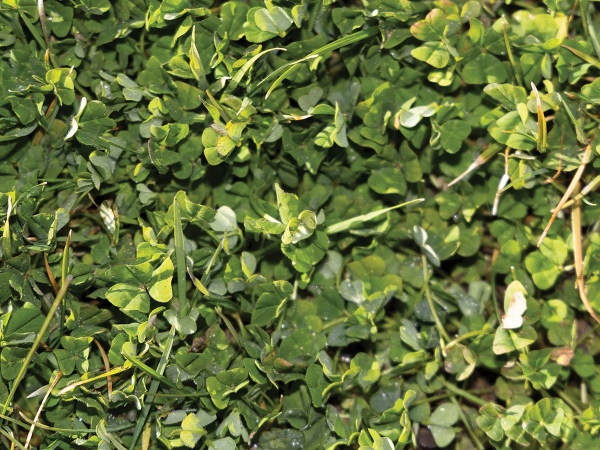
Farmers wanting to establish subterranean clovers in their pastures this autumn are encouraged by Beef + Lamb NZ to graze pastures down to 700-1000 kg DM/ha prior to sowing.
A hard grazing in March will open up the pasture, particularly after such a growthy season, and aid the germination of oversown subterranean (sub) clover seed.
If necessary, herbicide can also be used to reduce drymatter before broadcasting or drilling seed, it says.
Ideally, the seed should be oversown, direct-drilled or broadcast at 10 kg/ha and fertiliser applied if required.
Legumes need a soil pH greater than 5.5, an Olsen P of over 15 and sulphate-S of over 8.
Germination is triggered by rainfall of over 20mm. Once germination has occurred, the area should be spelled to allow establishment and the seedlings to reach the trifoliate leaf stage.
Over winter, the area can be lightly grazed, preferably by cattle, to keep the pasture at around 2000 kg DM/ha. This ensures the clover is not shaded. The area can then be used for lambing ewes before being shut up to allow reseeding in late spring.
Establishment methods
Because clover seed has adapted to germinate from seed burrs buried in the top 10mm of soil, drilling is the ideal method of establishment.
Success from broadcasting seed is more weather dependent and the best results are seen when seed is spread just before a prolonged wet spell in March or April, this can be difficult to predict. Immediately after broadcasting, stock can be used to trample the seed into the ground.
Rates and mixes
The recommended sowing rate of 10 kg/ha will generate about 100 established sub clover plants per metre square.
The best way to quickly build a large sub clover seed bank is to sow the clover alone or reduce grass seed rates down to under half of what would normally be used (e.g. 8-10 kg/ha of perennial ryegrass or 2 kg/ha of cocksfoot and plantain).
Alternatively, sub clover could be sown with rape (at 1 kg/ha or less if the soil is fertile) as the brassica will act as a nurse crop for the clover and provide a couple of grazings over winter.
Grass can be over-drilled the following autumn, after the sub clover has set-seed.
Cultivars
Sub clover cultivars vary considerably in flowering dates, leaf size, pest and disease tolerance and hardseedness, so a mix of at least two complementary cultivars will compensate for site and climate variability. Luisetti Seeds has a range of sub clovers available, including Puawhaa, a variety bred specifically for New Zealand hill country environments.
As a rule of thumb, earlier flowering cultivars are better suited to low rainfall areas (under 500mm) whereas later flowering cultivars are adapted to higher rainfall areas (over 700mm).