The last two years have seen record vehicle sales in New Zealand, with prospective purchasers spending many hours picking the right vehicle, right model, right colour and chewing over the price.
One part of the new vehicle buying equation often overlooked but largely taken as a given is after sales support, particularly in respect of spare parts. It is often assumed that a plentiful supply of parts is always on hand, but the geographical constraints of NZ or the enthusiasm of the distributor might tell a different story.
A recent visit to European Motor Distributors Ltd parts operation near Auckland Airport gave the impression that this business intends extensive support of the brands it sells, which must surely lead to customer loyalty.
Twenty years ago the EMD parts operation was in the heart of the city with 2000sq.m of space and, in those days, largely focussed on the VW brand. The volume of parts amounted to one 20ft container arriving monthly in NZ.
Fast forward to 2013 when the Giltrap family, owners of EMD Ltd, realised that to support the success of their brands VW passenger and commercial, Skoda, Audi, Porsche and Seat, they needed to spend money on the parts support structure.
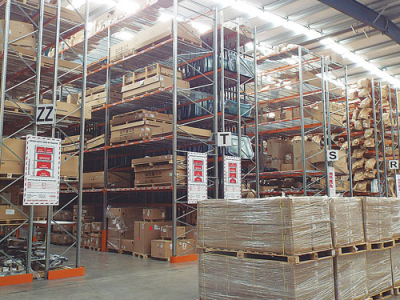
The company bought a site near the airport, erected a building and switched out of the central city, in a 6000sq.m building given over to supporting those brands. The building has a high roof space, a covered canopy for unloading in inclement weather and a one-way drive-through system.
Obviously, the volume of parts being handled has changed: nowadays 20 to 30 40ft containers arrive monthly from the VW-Audi Group global parts distribution hub in Singapore.
Carrying 55,000 line items to support the brands, and achieving a 93-95% picking rate, the operation has 40 employees on site, with 50% working in the warehouse.
Douglas Blair, general manager parts and distribution, explains “we operate a chaos system that is not as bad as it actually sounds. It means that parts for storage do not have fixed locations, rather the computer system picks the best available space when the part arrives to make the best use of the available space, and generally places parts of similar sizes in similar zones”.
Retrieval of parts for despatch to dealers is also controlled extensively by the computer system that directs warehouse operatives to item locations; these are scanned into a bin and ticked off the packing list.
Walking around the building gives a unique perspective on the task of keeping parts available for a big range of vehicles of different models, specifications and standard fitments.
Given that the operation might need to store a spark plug, rear windscreen, front fender or even a complete side panel for a VW Transporter Van, the range of storage locations and spaces is extensive, but displays a real commitment by this distributor.