A leading British farming politician says he's impressed with the positive attitude of New Zealand farmers that he met during his recent trip here.
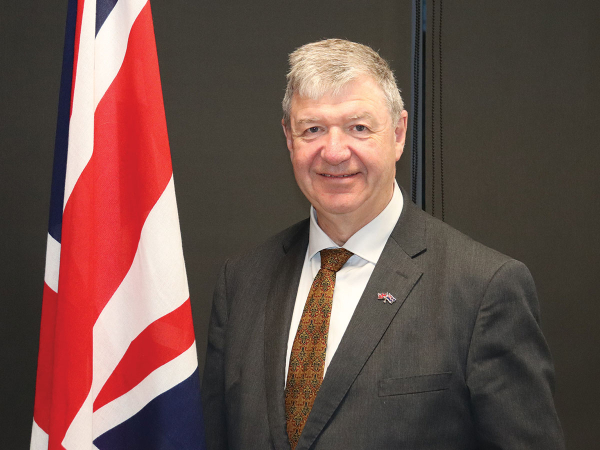
Alistair Carmichael, who heads Britain's influential Environment, Food and Rural Affairs Select Committee in the British Parliament, and some of his colleagues, were on a brief study tour of NZ to get a firsthand look at our farming system. Carmichael is a lawyer and owns a family cattle and sheep farm on the island of Islay in the Scottish Hebrides.
During his trip he met senior NZ politicians, farming leaders, visited farms in the Waikato and attended the National Fieldays.
"What I saw there was the positive spirit and mood in NZ farming, which is in sharp contrast to what the situation is like back home. There, people are feeling a bit under the cosh, milk prices are low, meat prices have been high and are now on the slide again, pigs can't get off the farm for slaughter and poultry is being pushed from pillar to post trying to make a profit," he says.
Carmichael says the most valuable conversations he had in NZ were with farmers, such as in the beer tent at Fieldays and on the farms he visited. He says these people have real skin in the game, in contrast to many of the policy makers and consultants where often the messages are 'filtered'.
He says the big issue now for the UK is food security and one of his reasons for coming to NZ was to look at the structural changes it made during the 1980s with the removal of agricultural subsidies. He notes that England has almost no production subsidies and the only ones it has are for environmental improvement and nature restoration.
"Conversely, while Scotland, Wales and Northern Ireland are on the same journey, they still have subsidies that are more production focused," he says.
Although Carmichael admires the move by NZ to remove all subsidies, he says there is no way that this model could be imposed on or work in the UK. He says the system worked for NZ in the 1980s, but 45 years on, the world is in a different space. He says while the move to bigger farms created efficiencies in NZ, in the UK and in other parts of Europe there is a mandate to protect smaller communities and preserve the natural environment.
"Preserving the smaller farming units, mostly run by single families, is an important part of the social structure of rural communities. Focusing on financial imperatives can often bring other unintended consequences on the way that people have to live. In the UK we can make political decisions about how we reform what is important to us. For example, how do we keep people farming in upland areas? It's about trade-offs about what things do [we] preserve as well as the things that we want to change," he says.
The Policy Maker Problem
Carmichael says a major problem for farmers in Britain are policy makers who have little or no understanding about the agriculture policies they make. He says this particularly applies to policy around climate change.
"For example, it was suggested in Scotland last year that we should reduce our livestock numbers by 35%. That would be the end of red meat production in Scotland and the end of communities in rural Scotland. They have also suggested that we could meet our food needs by imports - this is lunacy.
"So, this could be done it seems by importing all our food from, say Brazil, where beef has been produced on land that was reclaimed rain forest and probably to lower animal welfare standards," he says.
Carmichael says they seem to be missing the point that the climate crisis is a global issue and what they are suggesting is madness.
While most of Carmichael's time is devoted to politics as the MP for Orkney and Shetland, he keeps a close eye on the family farm where his elderly father still lives. He says it's important that farming is done in harmony with nature and he points to an example on his own farm. He says at one stage the farm was home to a rare breed of birds called Choughs that nest on the farm or nearby cliffs. He says these birds like to fossick around cow pats.
"My father got rid of the cattle and immediately the Choughs disappeared. So, I made a conscious decision to bring back cattle, which I like anyway, and suddenly the Choughs returned. This is all about respecting nature in the process of commercially farming a property," he says.
For Carmichael, the take-home message from NZ is that what it has done is good for NZ, but it's critical to have sensible workable policies that take into account the special needs of rural communities. This can only be achieved, he says, by getting direct input from farmers and having policy makers who have hands on experience of farming and who have not spent a lifetime confined to an office in the city.