fbpx
Print this page
Friday, 18 October 2024 09:55

Cultivating successful cow families

Written by  Staff Reporters
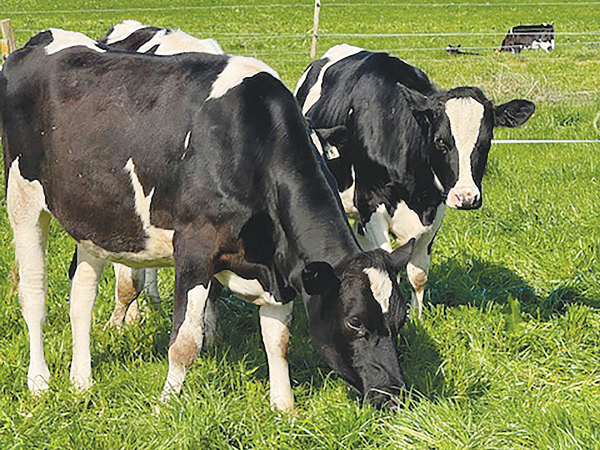
The Discovery Project focuses on identifying exceptional Holstein Friesian heifers. The Discovery Project focuses on identifying exceptional Holstein Friesian heifers.

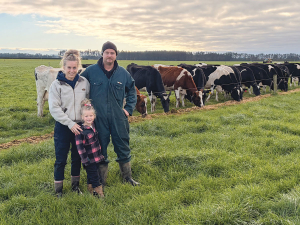
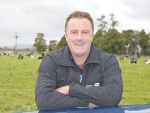
Michael and Cherie Berkers’ Holstein Friesian herd exemplifies how breeders can consistently develop successful cow families by seizing opportunities for improvement year after year.

Their Riverton sharemilking business, Moovin Aherd Ltd, has three heifers included in this year’s Discovery Project team, which features 24 heifers from 16 breeders across New Zealand.

The Discovery Project, a collaboration between Holstein Friesian NZ and LIC, focuses on identifying exceptional Holstein Friesian heifers with the potential to significantly impact the AI industry.

Each heifer selected participates in a Trans-Vaginal Recovery (TVR) programme, utilising advanced breeding technologies to produce genetically superior offspring, driving the evolution and enhancement of the Holstein Friesian breed.

This year, the Berkers successfully nominated three heifers: MAH Freestyle Sambie S1F (454/46gBW), sired by Prattleys Lucid Free-Style S1F and out of MAH Samba-ET S2F; MAH Lucid Indie (442/55gBW), sired by Woodcote VHR Lucid-ET S1F and out of MAH Grand Imogin S1F; and MAH Lucid Storm S1F (507/56gBW), sired by Woodcote VHR Lucid-ET S1F and out of MAH Fury Storm-ET S2F.

Cherie says Woodcote VHR Lucid-ET S1F, a bull out of 2018 Discovery Project team member Woodcote FU Laura-ET S3F VG85, was a sexed semen sire that resulted in many daughters.

“They are really nice calves,” Cherie says. “We use sexed semen on our best animals, and the results have been excellent.”


Read More


The Berkers have been nominating heifers for the Discovery Project on and off over the years. One of their first pedigree animals, 2014-born MAH HDF Starstruck-ET S3F, participated in the 2015 Discovery Project. Embryos were collected in the spring of that year, and calves were born in 2016. All three of her daughters went through the Discovery Project.

“The Discovery Project is a valuable programme,” Cherie says. “LIC provides support with sire recommendations for mating, as well as free semen, including from bulls that are not yet publicly available.”

HFNZ also offers discounted classification to all Discovery Project heifers when they are classified as two-year-olds.

Holstein Friesian NZ encourages its members to nominate their high BW heifer calves for the 2025 Discovery Project through the HFNZ website. Nominations close on February 21, 2025

More like this

Clostridial Disease in Lambs: NZ Vaccination Guide

Although preventable, lamb loss from clostridial diseases during the first year of life on New Zealand hill country farms continues to be an issue. A field trial, where lambs were vaccinated at docking and weaning, demonstrated that vaccination was highly effective, lowering clostridial deaths by 23%. Zoetis veterinarian Dr Victoria Chapman unpacks the importance of robust animal health programmes, vaccination timing and the potential harmful consequences for stock when vaccination isn't given.

BVD Control in Dairy Herds: How to Find & Remove PI Animals

Bovine Viral Diarrhoea (BVD) is estimated to cost New Zealand's dairy and beef industries more than $150 million every year, yet many of the tools needed to control it are already well understood. After more than 25 years in veterinary practice, Andrew Weir, animal health technical specialist at LIC, has seen firsthand the impact BVD can have on herd performance. We asked him about the role of persistently infected (PI) animals and the practical steps farmers can take to reduce their risk.

Transition Period: The Make-or-Break Window for Dairy Cows

The transition period is the make-or-break window for your entire season. If this period is poorly managed, you don't just see a few downer cows, you see a downward spiral that affects the cow's health, production and reproduction long into the season.

Managing Light Ewes at Scanning: Wormwise Advice

Scanning is a great time to start identifying and managing groups of ewes based on feeding priorities. Wormwise's Mary Bowron discusses some of the possible reasons ewes lose condition in early winter - and it's not necessarily internal parasites.

Featured

RSE Scheme Changes Coming - McClay

Agriculture Minister Todd McClay has admitted that a scheme bringing workers from Pacific nations to work on orchards has become too hard to navigate but says changes are coming.

Andy Macfarlane Joins AgriZeroNZ Board

Canterbury farmer Andy Macfarlane has been appointed to the board of AgriZeroNZ, the public-private partnership designed to accelerate the development and deployment of emissions reduction tools for New Zealand farmers.

National

Machinery & Products