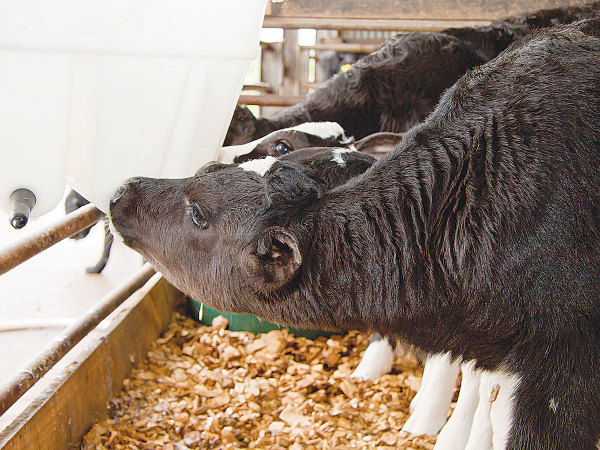
Feeding infected milk is high risk for spreading diseases such as M. bovis.
Milk that has the lowest risk of containing M. bovis bacteria comes in these forms: calf milk replacer powder, acidified milk, or pasteurised milk.
If you're feeding whole milk, consider the following:
- Discard milk from cows under treatment for mastitis or other illnesses.
- Aim for a pH level of 4.5 to reduce the risk of M. bovis. At a pH level of 4, the milk is unpalatable, and the calves will refuse to drink it.
- Pasteurisation will kill M. bovis if the machine is working correctly and the proper procedures are followed.
- Adding yoghurt to milk is a less reliable way to reduce the pH, as this process takes more time and is temperature, dependent to get the culture growing.
- If the pH doesn't drop below 5 for at least 8 hours, M. bovis will not be killed.
- The addition of potassium sorbate preservative does not kill M. bovis.
Advice for acidifying milk
Do not acidify below pH 4 as this will result in thickened milk and risks complete coagulation. Calves will not drink milk with a pH of 4 or below.
Milk must be less than 24°C to minimise coagulation or clot formation.
Always add acid to milk, not milk to acid.
When using citric acid, the rate is 5.5g citric acid per litre of whole milk, or 550g per litres of whole milk, or 5.5kg per 1000L of whole milk. The acid needs to be sprinkled on top of the milk while it is being agitated.
Milk at pH 5 and below separates, but with gentle mixing goes back into a homogenous solution. Gentle mixing of the milk twice a week is the recommended method. Continuous or vigorous mixing causes coagulation.
Use pH strips or an electronic pH meter. Note meters must be kept clean and calibrated when working with milk.
Systems that pipe milk may have coagulation in the pipes/tubes causing blockage of lines and nipples. This may result in the feeding of "whey" to calves.
Article - DairyNZ