An ambition within reach
A couple closing in on their ultimate farming dream is taking the first steps of another farming ambition – to own a line of registered pedigree Holstein Friesians.
 increase font size
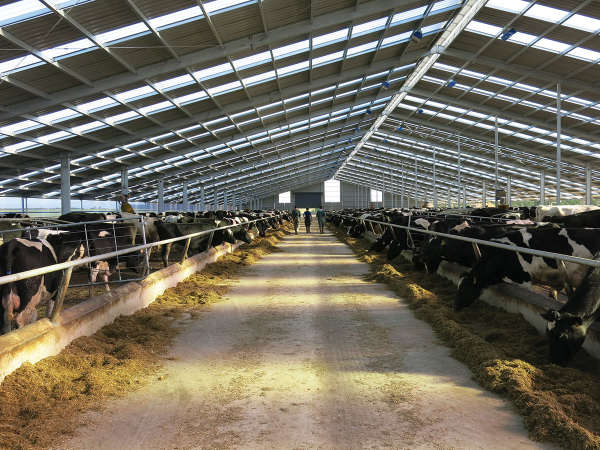 The barn allows cows to rest and avoid the stress on paddocks that occurs when cows hit the pasture hungry.
When Ian Smith built a 520-bed free stall barn on his Drummond dairy farm in 2014, it changed the way he farmed.
Whether it’s sheltering his 500-strong herd from Southland’s winter weather, fully feeding without wastage or allowing cows to rest and ruminate between milkings, the barn is the engine room of Ian’s operation, providing year-round flexibility, feed efficiency and comfort.
Ian has sharemilked and leased the 200ha Southland farm from his family trust for the past 25 years and, alongside partner Kath Taylor, has built a system that not only supports his highproducing Holstein Friesian cows – producing 500kgMS per cow – but mitigates the challenges of flat land, heavy animals and unpredictable weather.
“The farm is flat and, supporting heavy Holstein Friesians, means the water either evaporates or runs off – it doesn’t go through,” Ian says.
The barn allows Ian’s herd to lie down to rest and avoid the stress on paddocks that occurs when cows hit the pasture hungry. It also buffers against common agricultural risks.
“There is also the risk of crop failures – they don’t always emerge,” Ian says. “Over winter, fully feeding without wastage is critical. We can also milk out of the barn during those months.”
How the barn is used changes with the seasons. Around May, when the weather turns wet and unpredictable, the cows graze during the day and sleep in the barn at night. In June and July, the herd is in the barn 24/7, with some still milking.
In August, when calving begins, the cows go back to spending the day in paddock and the night in the barn.
Supplementary feeding is tailored to the time of year, with Ian using a mix of quality silage, straw, dried distiller’s grain (DDG), pellets, molasses, and palm kernel (PK) in varying amounts. They are all delivered through a mixer wagon in the barn, ensuring consistent nutrition and minimal waste.
“Holstein Friesians really respond well to being fully fed,” Ian says.
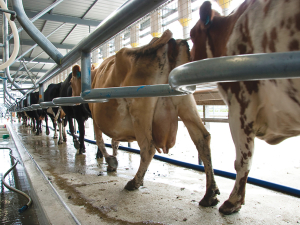
Milking takes place year-round under a unique management structure where cows are dried off in staggered phases: August cows at the end of May, September cows in June, and October cows by the end of August. In June, cows shift to once-a-day (OAD) milking, scheduled for 10am to let frosts thaw - a practical adjustment to Southland’s chilly mornings.
Ian milks through any empty cows that are first-time offenders for not getting in calf, as they still out-produce the younger heifers. Each cow in the herd follows a 300-day lactation with a 60-day break, and calving officially kicks off on August 10. About 20% of the calves are kept as replacements.
A major benefit of milking through, Ian says, is the ability to quickly reintegrate cows into the herd after calving. “Once the cow is cleared after birth - around four days - she can go back into the milking herd,” he says.
Mating begins November 1, starting with 4-5 weeks of artificial insemination (AI) using nominated semen, followed by a ‘saturation’ of the herd with the farm’s own Holstein Friesian bulls. In recent years, the whole herd has been DNA tested, including the calves, to confirm parentage - something Ian finds reassuring.
“It’s been quite good to ensure my recording is accurate,” he says.
When choosing semen Ian focuses primarily on milk components, followed by careful attention to traits like udder conformation and cow stature. Overseas genetics have played a strong role in improving udder quality.
“Good udders generally come with using overseas genetics,” he says, adding that while he’s ‘aware’ of breeding worth (BW) and production worth (PW), he’s cautious not to breed cows that are too large.
A couple closing in on their ultimate farming dream is taking the first steps of another farming ambition – to own a line of registered pedigree Holstein Friesians.
Maximising per-cow production has always been an interest of Manawatu dairy farmers Craig and Raewyne Passey - and Holstein Friesian cattle have proven the ideal breed to achieve this.
Farms across the upper North Island are trialling different pasture mixes as part of a research programme that aims to build greater resilience into farming systems.
Election years are always a concerning time for farmers, according to DairyNZ chair Tracy Brown.
The Ballance Farm Environment Awards are coming to the West Coast of the South Island.
Most dairy regions around the country have had a pretty good season so far says Tracy Brown.
Rural leader Mark Hooper has been appointed as an independent director to the NZPork board, bringing extensive farming, governance and advocacy experience to the role.