Red Meat Farmers Welcome Labour's Emissions Pricing Pledge
Red meat farmers are welcoming Labour’s plan to review the Emissions Trading Scheme and not to campaign on pricing agricultural emissions.
 increase font size
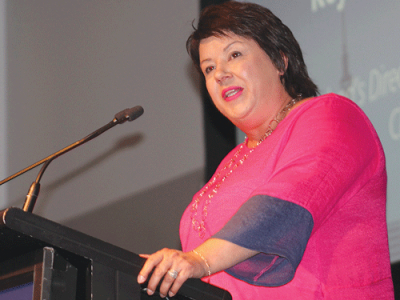 Climate change Minister Paula Bennett.
Climate change Minister Paula Bennett has ruled out bringing agriculture under the Emissions Trading Scheme (ETS) within the next few years.
But long term, if technology is available to reduce agricultural emissions the ETS is an option that could be used to ‘incentivise’ the use of that technology, she says.
The Government will in the next 18 months map its way forward in its response to climate change, Bennett told a Climate Change and Business Conference in Auckland last week. This follows New Zealand ratifying the Paris agreement earlier this month, joining a group of countries responsible for 55% of global carbon emissions.
The climate change agreement move is much faster than expected, several international speakers said.
NZ’s Paris target – a 30% reduction from 2005 emissions levels by 2030 –is “fair and ambitious, and will not be easy for us to reach,” Bennett says.
But she told Rural News there is no intention at this time to bring agriculture within the ETS.
“But I don’t know what it will look like in 10 years. [It may not] affect productivity – in fact some research they’re doing could enhance it – and there are options for reducing emissions such as inhibitors and others that can achieve reductions of 30-50%. You have to look at the uptake of that and how you incentivise it.
“The ETS could be one of the options in the mix, but we’re not looking that in the next few years.”
The aim is to get more consistent practice on farms and that is one area a new technical advisory group will be looking at to reduce emissions farm by farm, Bennett told the conference.
A range of technology is already under investigation: vaccines, inhibitors, breeding out a percentage of methane emissions, mainly from cows but also from sheep.
Bennett says the next 18 months will be critical in planning NZ’s response to climate change.
“It will require change by all parts of NZ society but I have no doubt NZers are up for it,” she says.
“Large parts of our plan are already underway, and our target will be met through a combination of domestic emissions reductions, removal of greenhouse gas emissions from the atmosphere by forests, and international carbon markets.
“The Government is looking at pulling together the various threads required to figure out a mix that works for our particular domestic circumstances.”
The technical advisory group announced a few weeks ago will provide strong evidence and analysis on an economy-wide approach to adapting to the effects of climate change. Its members and terms of reference will be announced soon.
This group will complement the work of the biological emissions and forestry reference groups announced recently by Primary Industries Minister Nathan Guy.
MPI will fund 13 research projects in agriculture and forestry totalling $3.1 million through its Sustainable Land Management and Climate Change research programme.
Some key pieces of work from the Government’s plan are underway, says Bennett.
“We are now halfway through the ETS review, and the most forceful message we have heard so far is that increased policy stability and certainty are critical.
“Businesses need to know where policy is heading over the next five, 10 and 15 years so that they can have confidence when investing in new technologies.
“We’ve also heard a lot from foresters, especially that they want higher carbon prices and increased policy stability.”
The carbon price is now about $19/tonne compared to about $7/t at the same time last year. They are now focused on making sure the NZ ETS gives more policy stability.
“We’re committed to working with the forestry and agriculture sectors to identify what’s possible in these sectors, and what the benefits and costs of certain actions are,” says Bennett.
Too many people still switch off when they hear the words climate change, she says, because it seems overwhelming and complex.
When she speaks to farmer audiences she reminds them how much they have changed already.
“Farmers don’t farm like they used to – they wouldn’t be in business if they did. Consumer pressure is changing how businesses think about the footprint they are leaving…. They have already made big adjustments to the way they live and operate over the last 15 or so years.”
Red meat farmers are welcoming Labour’s plan to review the Emissions Trading Scheme and not to campaign on pricing agricultural emissions.
The New Zealand Institute of Forestry (NZIF) says unnecessary changes to New Zealand’s Emissions Trading Scheme (NZ ETS) will seriously erode investor confidence and result in significant reductions in forest planting rates.
For the first time in a quarter of a century, Federated Farmers has something positive to say about the Labour Party’s climate change policy leading into a general election.
Climate, nature and animal wellbeing make up Fonterra's refreshed sustainability roadmap released last week.
New Zealand's Emissions Trading Scheme (NZ ETS) encourages afforestation while not achieving climate goals, says a new report released by the Parliamentary Commissioner for the Environment, Simon Upton.


Waikato milk processor Tatua has again declared a record milk payout to farmer shareholders, leaving other processors in the dust.

A Labour-led Government won’t be bringing back the controversial freshwater rules of 2020.
National’s much-touted free trade deal with India featured in the Rural Issues Debate at Mystery Creek, Hamilton on Wednesday night.
New Zealand's 2026-27 freshwater fishing season has opened, with anglers encouraged to head to rivers and lakes over the coming days as conditions look favourable across much of the country.
Central Otago District Council (CODC) has voted against a plan to spread treated sewage sludge from Cromwell and Alexandra on farmland near Lauder, a decision Federated Farmers says reflects strong opposition from rural residents.
Pāmu has released its FY26 Integrated Annual Report, reporting a Net Operating Profit of $113 million, more than double the $49 million recorded in FY25.