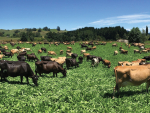
Treat your animals this summer
Sow the right chicory this spring, and even if the season turns dry, you’ll still be able to give your animals leafy green summer grazing that’s good for both them and your bottom line.
 increase font size
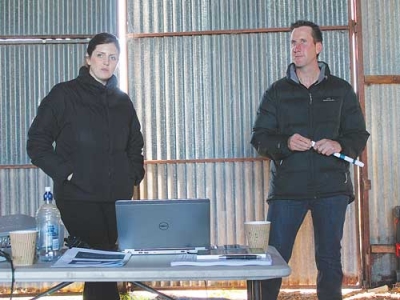 Megan and Michael Webster.
Chicory and its contribution to a $37,000 reduction in feed costs was a highlight in a tough year with the payout drop for the P3 Hauraki Focus Farm at Ngatea.
Sixty-six people turned out to a field day last Wednesday at the farm managed by Michael and Megan Webster, equity partners with parents Richard and Gillian Webster. The field day was one of about three held a year which can attract up to 80 people.
Webster Farms is in its second of three years as the focus farm for the P3 Trust, formed by nine farmers to increase farm profitability and sustainability across the plains for the benefit of the community.
P3 stands for ‘Productive and Profitable Plains’ and it has several projects run in conjunction with DairyNZ.
A focus at the Webster Farm is testing grasses and feed crops which grow well in the clay soils. The previous Focus Farm – Angus and Karen MacInnes’s property at Waitakaruru – had a focus on mating, DairyNZ consulting officer Fiona Wade told Dairy News. (The field day was one of Wade’s last duties before she moves on to sharemilking.)
The Webster farm saved $37,000 in feed costs in the financial year to May 31, 2015. This was attributed to chicory providing good yields over the summer period (150t) and also replacing maize with PKE: 116t more PKE was brought in than the previous year, but 250t of maize was taken out of the system.
Another calculation showed that had the milk price stayed elevated – at about $6.50/kgMS – the farm would have been $100/ha more profitable than the previous season, partly attributable to the use of chicory.
Chicory has been particularly successful as an interim crop before resowing pastures and this was backed up by other farmers at the field day who were also using the crop. It requires less handling than maize and the taproot serves well in dry conditions.
“The chicory has been a major success both as a summer feed and in getting our new grass programme heading along in the right direction,” says Michael. “The pasture has had a good strike and we’ve also done 50ha of undersowing this year; that is all taking shape and looking good.
“We have a far better understanding of feed budgeting and are far more pro-active then reactive. At the moment we have a rolling feed budget update and do a weekly update. We are forever trying to find little scenarios and gains we can make.
“We have a much greater understanding of our business – of where we are and where we’re heading.”
Megan says having to record a lot of information for the Focus Farm project gave them greater ability to make decisions than if they had been flying blind. “There are ups and downs but we get there in the end,” she says. The success graph is not always a straight curve up.
Milk production targets were not reached as it was hard to justify extra expenditure in this payout climate to chase production compared to the previous year. “Now we are being tested pretty hard as probably everyone in the room is,” Michael said.
Another farmer said after using chicory for three-four years there had been a marked increased in the persistence of new grass after the chicory because it got rid of a lot of black beetle larvae. “We have new grass that is four years old that is still good; going from grass to grass after three or four years we get pretty disappointed.”
With the switch to chicory and more PKE, Michael said he was not sitting on a tractor so much, and the PKE was utilised better than maize.
He said they don’t plan to put in more chicory as they think they have it “bang on”. He said he also thought they had “nailed” residuals and the staff also knew exactly what they were doing with residuals.
The focus for the next 12 months was getting the basics right, doing things better and working as a team. “Rather than doing things averagely, like everyone in this room we aspire to be in the top quartiles. That really drives us,” Michael said.
Sow the right chicory this spring, and even if the season turns dry, you’ll still be able to give your animals leafy green summer grazing that’s good for both them and your bottom line.
A large dairy farmer turnout at a recent effluent management field day shows they want to do the right thing with the environment, says organiser Jon Palmer.
Winners' field day goers witnessed the spectacular scene of more than 75 cars snaking through the back tracks of Omarama station.
One response to tight economic circumstances for many dairy farmers is to look at reducing the amount of feed they buy in for their cows, says fertiliser co-op Ravensdown.
The North Island does not have enough groundwater to irrigate, as does the South Island. Even if it did, given the dairy payout, irrigation is unaffordable.



Fonterra has revised its Farmgate Milk Price forecast for the 2026/27 season, lifting the midpoint and narrowing the range on the back of improving global dairy commodity prices.
New Zealand's citrus growers were challenged to build their future on the value embedded in their fruit rather than the volume they produce, at Citrus New Zealand's annual gathering in Gisborne on 17 September.
Leading John Deere technicians and apprentices from New Zealand and Australians were recognised at the recent sixth annual JD Technician of the Year Awards, held in Brisbane.
In Dacre, near Invercargill in New Zealand’s South Island, Bruce Dinnington is running a dairy operation unlike any other.
A free online platform aggregating governance vacancies across rural and regional New Zealand has been launched.
Environment Minister Nicola Grigg has announced details of a new rural plastics recycling scheme.