Safer Farms Champions Promote Quad Bike Crush Protection Devices
Safer Farms Regional Champions are putting Crush Protection Devices (CPDs) through their paces and sharing their first-hand experiences with other farmers.
 increase font size
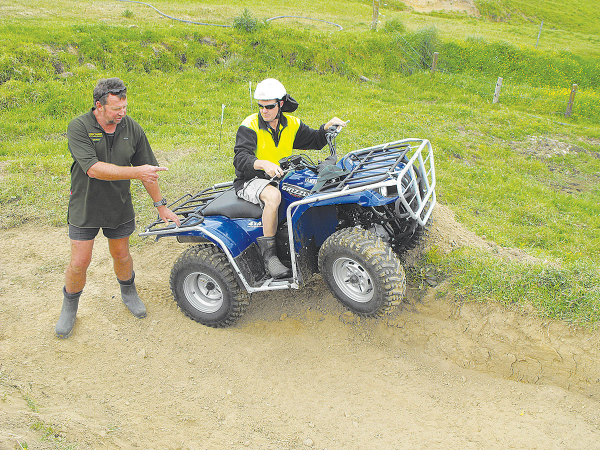 WorkSafe is offering safety tips for ATV/quad bike riding this summer holidays.
Last year saw a major shift in the supply of ATVs or quad bikes in the Australian market, with the Consumer Goods (Quad Bikes) Safety Standard 2019 coming into effect on 11 October 2021.
The standard was introduced to improve the safety of quad bikes, which are a leading cause of death and serious injuries on Australian farms: All new and imported second-hand quad bikes offered for sale in Australia, in all categories, must meet certain requirements of the US or European quad bike safety standards and have a hang tag attached displaying the angle at which that model of quad bike has tipped onto two wheels when tested for stability.
They must also carry a rollover warning label, have a compliant spark arrestor fitted and be supplied with an owners’ manual that includes rollover safety information.
All new and secondhand imported generaluse quad bikes offered for sale must also meet the minimum stability requirements for lateral roll (sideways) stability, the minimum stability requirements for front and rear longitudinal (forward and back) pitch stability, and be fitted with an operator protection device or have one integrated into their design.
This last point appeared to cause the greatest concern to manufacturers, who said there was a lack of thorough testing as to the effect of fitting unauthorised devices, regarding stability and the changes to the centre of gravity. This point led to many withdrawing from the ATV market completely.
Brought about by the need to address the 180 deaths associated with the use of quad bikes since 2011, statistics look to have been on a downwards path anyway – probably through much better operator training – with the number of deaths reduced significantly from the 24 lives lost in 2020, to 11 in 2021 and 9 so far in 2022.
Since the October 2021 deadline, the ACCC has worked with state and territory consumer protection and health & safety agencies to conduct a second annual round of surveillance activities, inspecting over 440 quad bike dealers in the process. The authorities are currently investigating a small number of instances where potentially serious non-compliance was identified, including in relation to the safety of the operator protection devices.
Summing up progress, 94% of new quad bikes assessed by the ACCC regulators were compliant with the national safety standard, an improvement from the 84% recorded in 2021. Non-compliance was mainly due to machines being displayed without age or rollover warning labels, lateral roll stability tags or owner manuals.
Back here in New Zealand, with the holiday season fast approaching and the increased chances of non-rural youngsters trying their hand at ATV riding, our own safety authority, WorkSafe, offers the following ATV/ quad bike riding tips:
- Ensure you are properly trained before you ride a quad bike
- Always wear a helmet and appropriate clothing
- Never let children ride quad bikes that are meant for adults - even as passengers
- Do not carry any passengers on quad bikes that are meant for one person
- Avoid riding on rough terrain or steep slopes
- Take extra care in wet weather and be aware of obstacles
- Never ride under the influence of alcohol or drugs
- Ensure children are supervised at all times near any quad bike activity
- Fit Operator Protection Devices to quad bikes minimise injuries or reduced the risk of death
Safer Farms Regional Champions are putting Crush Protection Devices (CPDs) through their paces and sharing their first-hand experiences with other farmers.

It's hard to believe that quad bikes or ATVs have been around for about 50 years – even longer if you add in the balloon-tyred trikes that first appeared in the Bond movie Moonraker.
Federated Farmers says the farming sector has been unable to effectively address quad bike safety.
The launch of the new Safer Rides incentive programme will see farmers encouraged to install crush protection devices (CPDs) on their quad bikes to help reduce harm on farm.
WorkSafe New Zealand is reminding businesses that regularly servicing and maintenance quad bikes can save lives.


Waikato milk processor Tatua has again declared a record milk payout to farmer shareholders, leaving other processors in the dust.

A Labour-led Government won’t be bringing back the controversial freshwater rules of 2020.
National’s much-touted free trade deal with India featured in the Rural Issues Debate at Mystery Creek, Hamilton on Wednesday night.
New Zealand's 2026-27 freshwater fishing season has opened, with anglers encouraged to head to rivers and lakes over the coming days as conditions look favourable across much of the country.
Central Otago District Council (CODC) has voted against a plan to spread treated sewage sludge from Cromwell and Alexandra on farmland near Lauder, a decision Federated Farmers says reflects strong opposition from rural residents.
Pāmu has released its FY26 Integrated Annual Report, reporting a Net Operating Profit of $113 million, more than double the $49 million recorded in FY25.