fbpx
Print this page
Friday, 21 October 2022 09:55

Mixer wagons vital when pasture flops

Written by  Mark Daniel
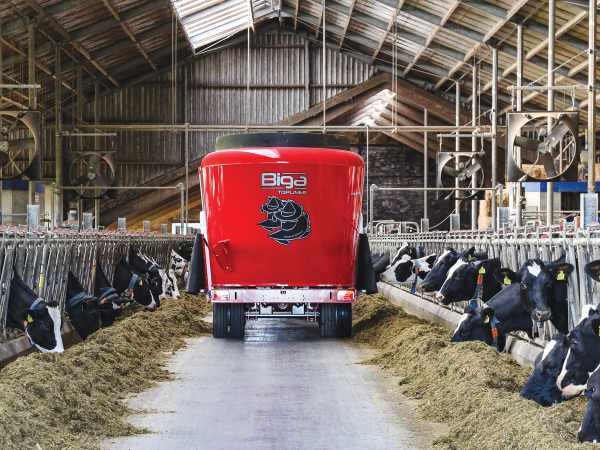
Most farmers would typically want to load a mixer wagon once per day/feed, so this will generally determine the size of mixer required. Most farmers would typically want to load a mixer wagon once per day/feed, so this will generally determine the size of mixer required.

While New Zealand dairy production is centred around ‘milk from grass’, over the last decade or so, many operators have found that mixer wagons can play an important part in maintaining, or indeed increasing production, particularly in periods of limited grass growth or drought.

Peecon mixer wagons are imported by FarmShop, based at Kaiwaka in Northland, who operate a direct sell model, rather than the more traditional importer/dealer/customer sales chain.

Manufactured in Holland for the last 25 years, Peecon has a unique shape to its mixer tubs, said to counter “belching” – where material tries to rise and spill over the walls. This is countered by an inwardly curved upper tub wall around the upper edges of the tub, which pushes material, particularly bales, back towards the centre of the machine and onto the auger assemblies.

Constructed using a 25mm thick hopper base plate and 8mm thick hopper walls, the auger assembly is manufactured from 17mm thick, cold-pressed steel, that is not compromised by any heat during construction. Said to feature a unique double-action, the auger system incorporates a slim centre shaft, that works in combination with the auger flights, that in turn carry 14 serrated born steel cutting blades, that are claimed to reduce power requirements and cut mixing times by up to 50%.

In addition, the sweeper assembly at the base of the auger serves to distribute any lower volume ingredients throughout the mix, while also ensuring the hopper is cleaned out completely at discharge.

The drivetrain of the Peecon mixers features a planetary drive layout and maintenance-free bearings, covered by a five-year warranty, with the mixing augers covered by a lifetime guarantee.

The weighing system integrates directly with the farm office PC, offering the ability to record individual mixes and monitor feed inputs against milk output as the season progresses. With ease of use in mind, an optional link to an auxiliary screen in the tractor or loading shovel can display details of a ration, recording weights and final tallies as they progress.

Currently stocking 14, 18 and 21 cubic metre machines, FarmShop notes that bespoke or customised machines can be indented from the manufacturer, typically over a 6 to 8-month period.  The importer also suggests that most farmers would typically want to load a mixer wagon once per day/feed, so this will generally determine the size of mixer required, roughly allowing one cubic metre of mixed ration per 20 cows.

More like this

Tractor Sales Fall in Most Major Markets Ahead of EIMA 2026

The market is in decline in the United States, Canada and Brazil. In Europe, sales are falling in Germany, France and Spain. Turkey is experiencing a sharp decline, whilst the economic strategies and policies implemented by India and China are driving purchases in both countries.

Waikato Dairy Family Uses John Deere Precision Tech

Areare Farms, a dairy operation in the Waikato region spanning multiple properties and milking 760 cows, now has Jenna and her brother Brian Rogers, the third generation of the family business, working alongside their parents Phil and Jackie.

SAM e-Spreader Now Connects Directly to Tabula

Hamilton-based manufacturer SAM Machinery and Hawke’s Bay’s Tabula have joined forces to offer customers more ways to connect its spreaders with the technology they already use in the cab.

Claas Balers Turn 30

Claas built its first variable chamber round baler - the Variant 100 - in 1996, so 2026 marks 30 years and the fifth generation of the Variant name, recently complemented by the new Cerex Series introduced in 2025.

Featured

Students' Strobe Light Targets Nesting Birds in Tractors

During the nesting season, from September to December, industrious starlings can quickly build nests in the darker areas behind tractor and vehicle, usually close to hot engines, typically resulting in localised damage or in some cases complete write-offs.

NZ Tractor Deliveries Up 5% Year to Date to September

With the last couple of months having seen some potential tractor purchases put on hold with the impending election and continued input cost rises, year-to-date figures, ending September, has seen deliveries up around 5% over the same period in 2025, with a total of 2026 units.

MPI's Diana Reaich on Non-Tariff Barriers and Trade Access

The head of the Ministry for Primary Industries (MPI) trade and international relations group says New Zealand is well-positioned to secure trade access and compete internationally as the world becomes more complicated, demanding and uncertain.

National

Machinery & Products