Turning data into dollars
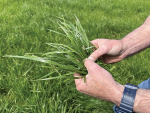
If growing more feed at home adds up to $428 profit per tonne of dry matter to your bottom line, wouldn’t it be good to have a ryegrass that gets you there quicker?
 increase font size
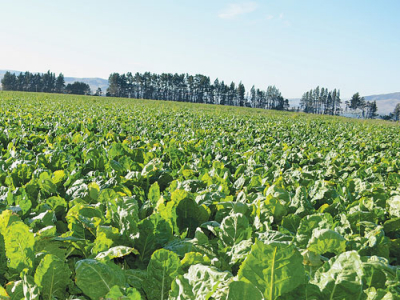 Fodder beet is a popular winter feed.
Fodder beet, while having been grown in New Zealand for many years, has only recently gained popularity as an important part of dairy cow winter feeding systems.
Increasing use is allowing DairyNZ to better understand the issues associated with feeding this crop. The key to successful use of fodder beet for non-lactating (dry) cow grazing is to follow good practice and not cut corners.
Transitioning cows onto fodder beet
- Make accurate yield and dry matter (DM) measurements, especially in the area to be allocated during transitioning
- Transition cows carefully by slowly introducing them to fodder beet. Decrease the proportion of pasture/silage and increase the amount of fodder beet in the diet over 14-21 days.
- Start mature cows on 1-2kg DM fodder beet/cow/day and only increase by 1kg DM every second day to the required allocation. Do not keep raising the allocation if all cows are not eating beet or bulbs are being left on previous days’ breaks. Start heifers and rising yearlings on 1kg DM fodder beet/cow/day and only increase by 0.5kg DM every second or third day once all animals are eating.
- Rising two-year-old heifers and rising one-year-old calves will be slower to take to eating the bulbs and will sometimes benefit from splitting bulbs by, say, a tractor wheel, to get them onto the crop.
- If transitioning onto unrestricted (ad lib) fodder beet, do this over at least 21 days. After transitioning to 7-8kg DM fodder beet hold this allocation for seven days and then slowly increase the break line a little each day until the cows leave fodder beet behind to achieve ad lib intake. These cows still require 2-3kg DM/day of a good quality fibre source (silage, straw, hay).
- Work out your break size accurately: measure the rows, yield and width of your paddocks. Remember cows can graze under the fence by up to 1m so include this area in the allocation.
- Offer a wide enough face of fodder beet so that all animals in the mob can access the crop at the same time. In paddocks without a grass headland to provide additional space at the start of transitioning, or very high yielding crops, harvesting the beets in the headland and using these for the first few days of transitioning is an option.
If growing more feed at home adds up to $428 profit per tonne of dry matter to your bottom line, wouldn’t it be good to have a ryegrass that gets you there quicker?
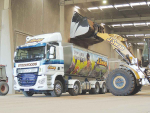
When buying supplementary feeds, farmers need to consider the entire package on offer – service, freight and all the components in a feed mix – not just focus on the price of the cheapest component – palm kernel meal, according to J. Swap Stockfoods sales manager Joe Hardman.
Two high producing Canterbury dairy farmers are moving to blended stockfeed supplements fed in-shed for a number of reasons, not the least of which is to boost protein levels, which they can’t achieve through pasture under the region’s nitrogen limit of 190kg/ha.
OPINION: Few things are more stressful for dairy farmers than running out of feed when cows need it most.
Now is not the time to stop incorporating plantain into dairy pasture systems to reduce nitrogen (N) loss, says Agricom Australasia brand manager Mark Brown.


Farmgate lamb prices are down by 8%, beef cattle by 4.5% and farm expenditure up by 4.2%.
Kiwifruit growers are watchful but remain optimistic as concerns around the potential effects of the El Niño weather pattern this season.
Almond hulls sourced from Australian orchards may have the potential to help New Zealand cows reduce emissions, boost milk yield and lower input costs.
Striking a balance between meeting the needs of industry to speed up approval time for products but on the other hand ensuring that risks are properly assessed.
Surprised, humbled and quite thrilled. That’s the reaction of James Allen, one of the founding partners and now chief executive of AgFirst, on being made a life member of the Institute of Rural Professionals.