Boosting Crop Production by Spreading Effluent
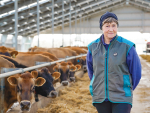
Tararua district farmer Jamie Harris milks around 400 cows using a split calving system on his farm, Crossdale Dairies.
 increase font size
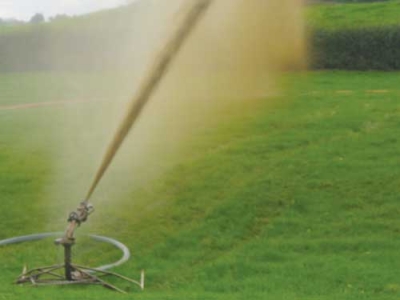 The larger the delivery hose, the better.
Effluent has become a big topic over the last few years, with major pressure being put on farmers by their regional authorities to clean up their act.
While there has been major investment in effluent ponds and storage tanks, what are the mechanics of getting ‘harvested’ effluent out onto paddocks to unlock its full potential?
There is a common misconception that to pump effluent over any reasonable distance from a storage area you will need a pump with high flow rates and high pressure.
Anyone who has sweetened the missus up by creating a water feature in the garden will know that the flow over the waterfall needs lots of water to create the desired effect – it’s advisable to use larger diameter hose.
The physics of the matter is quite simply friction. When pumping with a 150mm delivery hose, the pressure drop resulting from frictional losses will be only about 25% of that in a system using a 100mm hose.
Looking at a typical 100mm set-up with a flow rate of 150m3/hr pumped over 1000m, the likely pressure drop is about 12.6 bar, and the effluent will travel at 4.5m/sec.
Upsizing to 150mm hose with a corresponding set-up will see a system pressure drop of only 4.8 bar, and the effluent travels in the pipe at a speed of 3.04m/sec.
So it stands to reason that if you can reduce your overall system requirements for very high pressures by fitting bigger diameter hoses, there is huge potential saving fuel for the pumping tractor and a corresponding reduction in wear and tear on the pump and the pipeline, while delivering the required volumes of effluent during the working day.
We can look at the mechanics in more detail by comparing four typical set-ups, all trying to deliver 170m3/hr:
System 1
600m of 150mm supply hose; pressure loss 1.52 bar
400m of 125mm drag hose; pressure loss 2.41 bar
Total pressure required 3.93 bar
System 2
600m of 150mm supply hose; pressure loss 1.52 bar
400m of 100mm drag hose; pressure loss 6.34 bar
Total pressure required 7.86 bar
System 3
600m of 125mm supply hose; pressure loss 3.62 bar
400m of 100mm drag hose; pressure loss 6.34 bar
Total pressure required 9.96 bar
System 4
1000m of 100mm supply hose; pressure loss 15.86 bar
Total pressure required 15.86 bar
Note that in examples 1 and 2 the output requirement of 170m3/hr was achieved with a tractor running at 1450 engine rpm, and the pressure requirement in example 4 is not achievable even with the best products in the marketplace.
So while it’s sensible to do some homework and find the best pump and spreader system for your particular operation, don’t overlook the need for a pipe that can deliver the volumes with low pressure drops.
A 150mm pipe might show a reduced effluent speed in the pipe, but that pipe has a 50% greater carrying capacity and is the easy way to get high daily delivery rates and reduced fuel/power costs.
Tararua district farmer Jamie Harris milks around 400 cows using a split calving system on his farm, Crossdale Dairies.
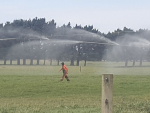
Water management is an integral component of sustainable farming practices, according to Watermetrics.
Two farmers and two farming companies were recently convicted and fined a total of $108,000 for environmental offending.
A Taupiri farming company has been convicted and fined $52,500 in the Hamilton District Court for the unlawful discharge of dairy effluent into the environment.
Founded in Germany as recently as 1977, today, the Fliegl Group employs more than 1100 workers, offering an expansive range of transport solutions, from their base in Bavaria.


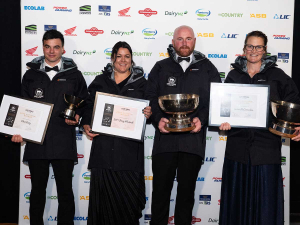
Entries opened on Monday, 5 October 2026 for the 2027 New Zealand Dairy Industry Awards (NZDIA), which organisers describe as the nation's biggest celebration of excellence in the dairy sector.
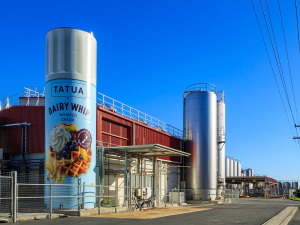
Waikato milk processor Tatua has again declared a record milk payout to farmer shareholders, leaving other processors in the dust.
A Labour-led Government won’t be bringing back the controversial freshwater rules of 2020.
National’s much-touted free trade deal with India featured in the Rural Issues Debate at Mystery Creek, Hamilton on Wednesday night.
New Zealand's 2026-27 freshwater fishing season has opened, with anglers encouraged to head to rivers and lakes over the coming days as conditions look favourable across much of the country.
Central Otago District Council (CODC) has voted against a plan to spread treated sewage sludge from Cromwell and Alexandra on farmland near Lauder, a decision Federated Farmers says reflects strong opposition from rural residents.