Boosting Crop Production by Spreading Effluent
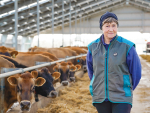
Tararua district farmer Jamie Harris milks around 400 cows using a split calving system on his farm, Crossdale Dairies.
 increase font size
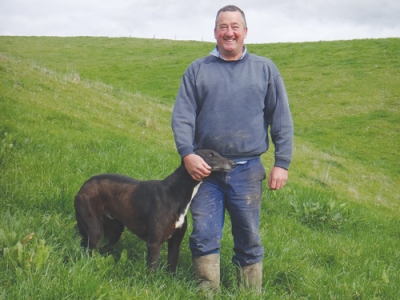 Farmer Andrew Holma, Gippsland, Victoria.
The management of dairy effluent provides many opportunities for dairy businesses in Australia.
The Holman family of Gippsland, Victoria, has met the challenge of effluent application on a steeper property through expanding their application area by installing a mainline last year, and are starting to see the benefits of improved pasture growth.
The Holman property is located at Loch in the Strzelecki Ranges, and has some steep slopes across part of the farm which makes the pumping of effluent particularly challenging.
The dairy operation milks about 400 spring calving cows. Manure from the yards is collected into a solids trap and a 50,000L sump. The sump is pumped daily to pasture using an effluent pump via a 1300m mainline and a gun irrigator.
Expanding the effluent application area has enabled better use of the nutrients in the effluent, particularly potassium and nitrogen.
The gun irrigator is moved around every couple of days and Holman has noted: "I'm able to apply nutrients now to areas of the farm that were difficult to drive over and apply fertiliser to and we're really able to see a response."
The effluent was tested and in one megalitre contained 232kg of potassium, 95kg of phosphorus, 22kg of sulphur and 200kg of nitrogen.
This is equivalent to around 0.46 tonnes of potash and 0.43 tonnes of urea and 1 tonne of single superphosphate with an approximate value of A$1015 per megalitre (prices are a rough guide to illustrate value of effluent).
Each year approximately 7.4 megalitres is generated on the property with a fertiliser equivalence value of around A$7511.
Reducing the on-going maintenance cost of the effluent system is also needed to gain the most value from the nutrients in the effluent.
Management challenges for the Holmans' effluent system include being able to generate enough pressure at the irrigator and managing solids so they don't create blockages in the pipes.
Holman used a plumber to size the mainline to ensure it was the right pressure rating for the steeper property to ensure pumping efficiency and reduce the risk of splitting pipes.
Solid material from the effluent is removed by a trap but some solid material does enter the sump which gets agitated and applied daily to pasture.
He notes that having the ability to flush the mainline is important to remove solid material if it does get pumped through.
Placing hydrants at 50m intervals for the first 200m of the mainline then 100m after that is something he would do differently next time to enable ease of flushing.
Holman also removed the foot valve on the effluent pump (which is immersed on a pontoon) to allow effluent in the line to drain back to the sump when turned off to flush the pipe.
The mainline has also been buried to protect it from stock trampling, and to help reduce blockages by keeping the pipe cool over summer, reducing the baking of manure inside.
Two posts and horizontal rails have been placed around the hydrants to protect them from stock and machinery.
He prefers managing the effluent on a daily basis. "At the end of each milking the effluent is gone; it's not another job that I have to do. There are no excavators, tankers or weeds on dams to deal with later."
These are the benefits of a direct application system; however it can be difficult to manage these systems when conditions are wetter.
Tararua district farmer Jamie Harris milks around 400 cows using a split calving system on his farm, Crossdale Dairies.
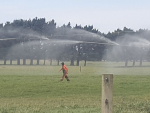
Water management is an integral component of sustainable farming practices, according to Watermetrics.
OPINION: Your old mate hears an international incident is threatening to blow up the long-standing Anzac alliance as Kiwis and Aussies argue over who wants new Australian resident and former NZ Prime Minister Jacinda Ardern.
Two farmers and two farming companies were recently convicted and fined a total of $108,000 for environmental offending.
OPINION: Your old mate hears that at a recent China Business Summit, PM Christopher Luxon delivered a none-too-subtle "could try harder" report card on the red meat industry regarding its exports to China - particularly when compared to Australia.


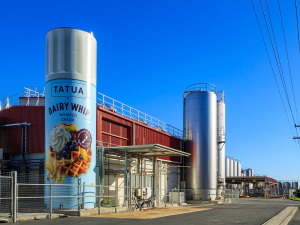
Waikato milk processor Tatua has again declared a record milk payout to farmer shareholders, leaving other processors in the dust.

A Labour-led Government won’t be bringing back the controversial freshwater rules of 2020.
National’s much-touted free trade deal with India featured in the Rural Issues Debate at Mystery Creek, Hamilton on Wednesday night.
New Zealand's 2026-27 freshwater fishing season has opened, with anglers encouraged to head to rivers and lakes over the coming days as conditions look favourable across much of the country.
Central Otago District Council (CODC) has voted against a plan to spread treated sewage sludge from Cromwell and Alexandra on farmland near Lauder, a decision Federated Farmers says reflects strong opposition from rural residents.
Pāmu has released its FY26 Integrated Annual Report, reporting a Net Operating Profit of $113 million, more than double the $49 million recorded in FY25.