V300 robots debut in Karaka
A small organic farm in South Auckland has become the first NZ recipient of DeLaval’s new robotic milking system, the VMSTM V300.
 increase font size
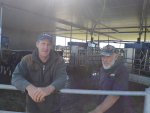
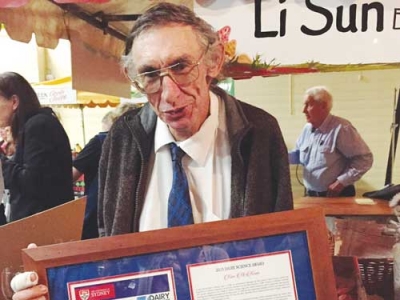 University of Sydney’s Kim McKean with his award.
Fifty years is a long time to work in one industry, and long enough to witness lots of change.
Just so for Kim McKean, manager of the University of Sydney’s dairy operation at Camden, New South Wales who recently received the Dairy Science Award from the Dairy Research Foundation in recognition of his service to the industry.
He started as an animal attendant in 1966 and over the decades has trained thousands of veterinary and animal science students in practical animal husbandry, and been on-the-ground support for at least 100 masters and PhD students.
Now he helps oversee the implementation of the university’s Corstorphine farm robotic rotary dairy.
“When I started we were milking in a little six bail walk-through dairy, putting the cups on the cows and washing their teats with an old cloth,” he said. “I never thought I’d see robots milking the bloody things; it’s amazing.”
The university campus has five farms over 350ha and milks 360-380 cows.
In August last year, the farm transitioned from a 40-a-side double up herringbone system to the automatic milking system developed by the university in partnership with Swedish company DeLaval, the NSW Department of Primary Industries and Dairy Australia.
The robotic rotary has an internal, rotary herringbone platform, with cows facing outwards and the robots housed in the centre.
The system does teat washing and drying, applies the milking cups, removes cups, disinfects the teats and flushes the cups. It also monitors milk yield and quality.
Commercial versions can handle 90 cows per hour depending on the number of robots installed and the daily operational procedure. The dairy can do 1500-1600 milkings per day, meaning the equipment could milk up to 800 cows twice a day.
McKean said it had been a steep learning curve since they first started using the system in August. “I’m not particularly computer literate, though I am now apparently. It’s been a challenging 12 months, but we’ve got it going and it’s working well.”
The cows had settled into the new way of milking within a couple of days but they took longer to adjust to the voluntary cow traffic.
“I’ve always known animals are not stupid but this has reinforced just how smart they are. It only takes a couple of days for them to work out the new system. And from an animal welfare and cow comfort point of view the system is fantastic, because the cows move to the milking system voluntarily.”
The cows’ movements and eating patterns are monitored and tracked, and they are guided through designated gated areas to the milking area, knowing there is more food once they are milked.
“They love it. There’s no pressure on the cows, there’s no one yelling at them, they are not being jammed up in yards with lots of other cows. It’s good from that point of view.”
McKean said his biggest challenge adapting to the new technology was surrendering management to the system and trusting it to do the job.
“And someone has to be available to monitor the system, not necessarily be in the dairy, but be available to take automated phone calls from the system and to attend to an issue.”
That may mean a phone notification in the middle of the night to attend to a problem. “But the upside is, we start at 6am now and not 3.30am.”
He said 90% of the herd came to be milked during the night.
“We only get about 50-60% during the day and that’s because we do a lot of teaching of vet students here. It’s not the most appealing place to come (as a cow) when there is a high risk that you will be poked and prodded by a heap of students.”
McKean said adjusting to the robotic system had so far not made his life easier, but he can see it will as they get better at using it. “It’s definitely the way of the future.”
A small organic farm in South Auckland has become the first NZ recipient of DeLaval’s new robotic milking system, the VMSTM V300.
The operator of the world’s largest robotic farm under one roof is expanding.
Robotic milking is coming of age in New Zealand and interest has surged in the last six months, DeLaval’s Grant Vickers says.
MANY DAIRY farmers in the Gippsland region of Victoria, Australia, are caught in the same position as Trevor Mills a year ago. He was grappling with issues of farm scale on his 180-cow unit, trying to balance a need to increase the flexibility of his time against the economic realities of volatile milk returns and labour costs.
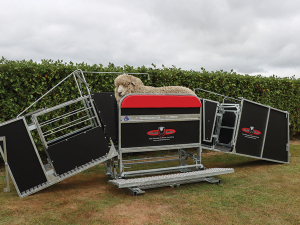
Oamaru-based livestock handling specialist Te Pari has bought Combi Clamp, the New Zealand manufacturer of Combi Clamp manual sheep handlers.
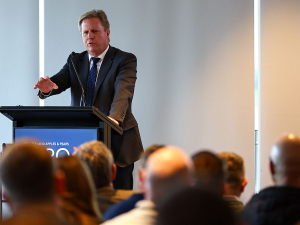
Agriculture Minister Todd McClay has admitted that a scheme bringing workers from Pacific nations to work on orchards has become too hard to navigate but says changes are coming.
A new app designed in New Zealand aims to help sheep, beef and deer farmers capture, analyse and use body condition score data more effectively.
Canterbury farmer Andy Macfarlane has been appointed to the board of AgriZeroNZ, the public-private partnership designed to accelerate the development and deployment of emissions reduction tools for New Zealand farmers.
For over 50 years Mel Ewers has been supporting the apple sector navigate through compliance and quality assurance issues.
The apple sector is enjoying a bumper harvest season.