NZ Beef Mince Now Over $24/kg as Export Demand Stays Strong
New Zealand consumers are paying more for beef mince than ever before, with the average retail price now sitting above $24 per kilogram, according to Rabobank.
 increase font size
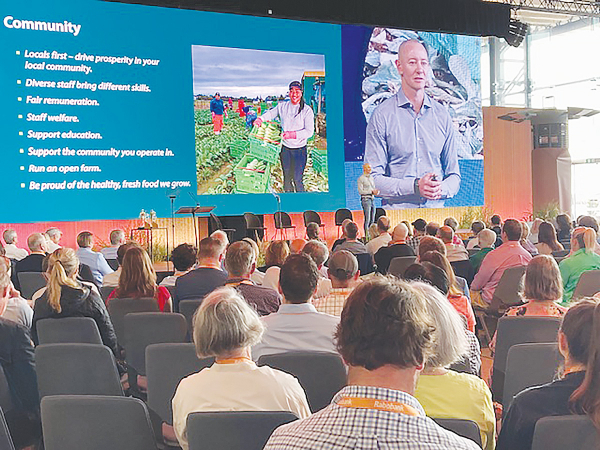 Jay Clarke giving his presentation on the sustainable practices of his company Woodhaven at the Rabobank agricultural symposium in Sydney last month.
One of NZ's largest commercial vegetable growers says NZ can't have piecemeal regulations that differ from region to region.
Jay Clarke is director of the family-owned commercial growing business Woodhaven in the Horowhenua, which was started by his father John.
Clarke was a keynote speaker at Rabobank's recent agricultural symposium in Sydney, which attracted more than 1,600 people from Australasia.
His presentation on the sustainable practices of his company Woodhaven attracted a lot of positive feedback from delegates at the event.
Clarke told Hort News he loved the event and it was great to meet a number of talented people from around the world and hear their perspectives. He was also pleased with the response to his address.
He says, at present, NZ has a variable regulatory approach between regions and that this needs to change.
"You have got a situation where a huge proportion of the vegetable production in the Horizons region is essentially illegal - it requires a consent and there is no pathway for a consent at the moment," Clarke told Hort News.
"But there are other regions like Northland where there is no regulatory requirement whatsoever - so there is a lot of difference. As an industry we want to see that tidied up and see nationally consistent pathways that enable more healthy food production."
 |
|---|
|
Woodhaven director Jay Clarke and manager Shane Richardson at the Rabobank agricultural symposium in Sydney. |
Clarke says few people argue about the direction taken in terms of sustainability but believes there is some valid debate about how things might change in terms of farm systems. He says times are changing and while the cost of vegetables will come down, the days of a 99 cent lettuce are gone forever.
Clarke says the cost base for the producer has moved too much and it's unsustainable for companies like his to sell at very low prices. He told the conference vegetable production is largely a domestic industry in NZ.
"It's quite remarkable that all the veggies sold in NZ are produced on just 0.01% of the available agricultural land."
Clarke says the family company Woodhaven has invested heavily in providing quality incentives for staff - including scholarships. He says this is for good reason as crops need good skilled people to harvest them - especially with the type and perishability of the crops Woodhaven produce.
New Zealand consumers are paying more for beef mince than ever before, with the average retail price now sitting above $24 per kilogram, according to Rabobank.

West Otago dairy farmer Luke Kane has been awarded the 2026 Rabobank Dr John Morris Business Development Prize.
Twenty five secondary school students from around New Zealand recently completed a three day residential programme designed to explore career opportunities across the food and fibre production supply chain.
OPINION: With 10,500 dairy farms, New Zealand continues to punch above its weight around the world.
A team effort that is paying dividends for the wider New Zealand economy.



New Zealand's pest problem has reached crisis point, according to Federated Farmers' second National Pests Survey, which shows farmers are spending more money and effort on control — yet pest numbers keep climbing faster than they were two years ago.

Testing confirms H5 bird flu in a single northern giant petrel, found dead on a remote Cape Palliser beach in the Wairarapa, says Dr Mary van Andel, the Ministry for Primary Industries' (MPI) Chief Veterinary Officer.
"What's for dinner?" may sound like a simple question, but for many Kiwi parents, answering it has become a job in itself.
Fifty Eight years ago, on the 16th of August 1968, August Claas, the founder of the harvesting company and father of Helmut Claas, personally presented a Claas Senator combine harvester to Scottish farmer John Steven.
New Zealand consumers are paying more for beef mince than ever before, with the average retail price now sitting above $24 per kilogram, according to Rabobank.
State farmer Pamu has delivered its strongest operating result on record.