Rabobank Launches HortPathways for Emerging Hort Leaders
Twenty-eight emerging leaders from across the horticulture sector spent two days last month learning valuable skills and connecting with industry experts.




 increase font size
Kiwis are wasting less of their food than they were two years ago, and this has been enough to push New Zealand’s total household food waste bill lower, the 2025 Rabobank KiwiHarvest Food Waste survey has found.
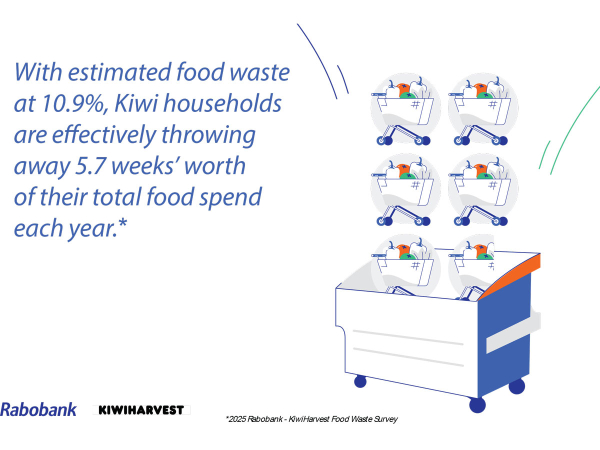
The survey – done in late July – found the average New Zealand household reported wasting 10.9% of the food they bought each week, back from 12.2% in the 2023 survey. This fall drove a drop in annual food waste per household (down to $1,364 from $1,510 in 2023) and a reduction in New Zealand’s overall food waste bill. This fell to $3 billion per annum from $3.2 billion (fall of 6.25%) despite marginal increases in weekly household food spend and the number of households.
Rabobank partnered with food rescue charity KiwiHarvest in early 2020, as part of the bank’s wider commitment to work alongside its rural customers to support sustainable food production and its global vison around global food security. Rabobank has commissioned research examining Kiwis’ food waste habits since 2017 – the four most recent editions of the research (2021,2022, 2023 & 2025) in collaboration with KiwiHarvest – to help raise awareness of this issue and, ultimately to reduce the volume of quality food we currently produce that ends up going to waste.
The latest drop in household food waste was the second consecutive fall recorded by the survey, following a reading of 13.4% in the 2022 survey.
KiwiHarvest CEO Angela Calver said it was encouraging to see food waste trending lower across recent years.
“It’s really pleasing to see things are heading in the right direction. However, this year’s estimated food waste, valued at $3 billion, is still too high and remains a major concern,” she said.
“At average annual waste of 10.9% per household, Kiwi households are effectively throwing away nearly six weeks’ worth of groceries each year.”
Calver said with more Kiwi kids now living in households where food regularly runs out, demand for KiwiHarvest’s food rescue services had never been greater.
“Since the last food waste survey in mid- 2023, KiwiHarvest has increased the volume of food that we rescue by 52%, and we are now providing the equivalent of over 125,000 meals back into the community each week,’’ she said.
“With so many Kiwis in need, it’s crucial we continue to prioritise public education on food waste and ensure the amount of perfectly good food New Zealanders are wasting continues to fall.
“KiwiHarvest is committed to working with Rabobank and other partners to tackle this issue by empowering New Zealanders with practical information to help reduce food waste at home.”
Small improvements helping drive food waste lower, while Kiwis attitudes to, and knowledge of, food waste, were largely in line with 2023. Rabobank head of sustainable business development Blake Holgate said small improvements in a few key areas had helped drive the dip in estimated food waste recorded in the 2025 survey.
“The latest survey found there is now a larger group of Kiwis committed to addressing food waste with more saying they ‘strongly agree’ with statements including ‘I care about reducing food waste’ (33% strongly agree from 23%), ‘It annoys me when I waste food’ (38% from 30%), and ‘It annoys me when I see others wasting food’ (31% from 23%),” he said.
“The survey also found Kiwis’ knowledge of food production was on the rise with 37% saying they know ‘quite a bit’ or a ‘great deal’ about this topic, and this was showing up in growing food waste concerns related to the wasted efforts of farmers here in New Zealand and abroad.”
Holgate said these changes were filtering through to improvements in food waste related behaviours.
Twenty-eight emerging leaders from across the horticulture sector spent two days last month learning valuable skills and connecting with industry experts.

A 'tsunami' of milk from key exporting countries is winding down and this may be good news for New Zealand dairy farmers.
Chinese beef trade quotas and a looming suspension of Brazilian beef imports into the European Union are expected to reshape global beef trade flows over the remainder of 2026, with implications for New Zealand exporters, according to Rabobank's Q3 Global Beef Quarterly report.
New Zealand consumers are paying more for beef mince than ever before, with the average retail price now sitting above $24 per kilogram, according to Rabobank.
West Otago dairy farmer Luke Kane has been awarded the 2026 Rabobank Dr John Morris Business Development Prize.


High country stations, mixed sheep and beef farms, Māori-owned farms, corporates and family operations are among the nine commercial farms taking part in the Livestock Innovation Farming Transformation programme, known as LIFT.
OPINION: New health and safety guidance unveiled by the Government recently provides farmers greater certainty about what is expected of them when managing risks on farm.
The National Animal Welfare Advisory Committee (NAWAC) is seeking public feedback on proposed changes to the Code of Welfare for Rodeos.
A New Zealand initiative supporting farmers to restore the health of grazing landscapes has received international backing through the Regenerative Fund for Nature, a global collaborative fund supporting regenerative agriculture and the communities that produce natural fibres for the fashion industry.
Combine premium New Zealand products, blend in a family ritual and what do you get? A world-class functional drink.
Entries are now open across eleven regions for the 2027 New Zealand Dairy Industry Awards (NZDIA).




OPINION: It seems Canterbury processor Synlait is still in the doldrums.
OPINION: Get offside with New Zealand First leader Winston Peters at your own peril.




