Tony Egan: NZ Meat Processing More Collegial Than Before
The meat processing industry is much more collegial than it was in the past and is now more focused on common goals.
 increase font size
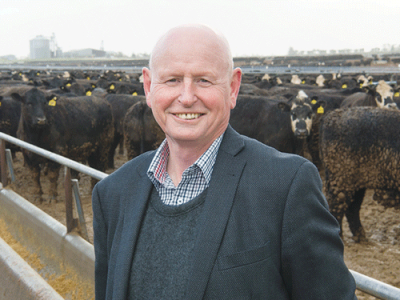 Anzco chief Sir Graeme Harrison.
More entrepreneurial spirit is needed in the New Zealand agri-food sector, says meat industry pioneer Sir Graeme Harrison.
“Leadership requires taking opportunities. One thing that worries me in NZ is [a lack of] entrepreneurial spirit and willingness to stick with a business for a long period of time,” Harrison told Rural News.
The chair of Anzco has won the 2016 Rabobank Leadership Award in recognition of his extraordinary contribution to the food, beverage and agribusiness sector. It is the second year in a row a NZer has won the honour; former Fonterra chair Sir Henry van der Heyden won in 2015.
Harrison says if you are in business long enough difficult things will happen, but this becomes a learning curve.
“You need to be resilient and you need a team of people to be resilient as well,” he says.
Leadership requires taking opportunities and getting the right people to execute them, he says.
“Getting the right people entails a whole lot of things: getting the shareholders, a suitable management team and, if you start in the market place like we have, it also about ‘going local’. Many of our overseas offices are manned by people who are local nationals.
“It is combination of all those things; obviously back in our plants we need very capable people to lead those and we need experienced supervisors.
“So it is a combination of those skills that make a business work.
“Someone can have the vision but we still have to get the right people – it won’t happen otherwise. People are the key to leadership.”
Asked if he thought the ag sector had enough leadership potential, he says NZ has the capability.
“But I’m worried we don’t attract enough people from the urban sector who see the real opportunities the agri-food sector can provide to the future of NZ,” he says.
“We already contribute over 70% of the country’s merchandise trade. But the prospects have never been better in terms of the growing middle class in Asia and our ability to service that.”
Trade liberalisation is vitally important to NZ, he says. Although Brexit and the US presidential campaign are current influences, we’ve got to keep up the efforts.
“I believe we will continue to be successful and the opportunities are there for us. So I want to see more urban people looking at careers in the agri sector.
“The ag sector has to get that message out [because] unfortunately there are still some people who have the view that the agri sector is old industry.
“Not at all; people are even more conscious of what they are eating. So the opportunities, particularly at a niche scale, are there and we need to take advantage of those.
“The ag sector needs to look at skills right along the chain – everything from servicing customers and reacting to those in the marketplace right back to skills in adding value to our products.
“That is much harder than people imagine. It is a very, very difficult process. You have to have medium to long-term views. If you get short term wins you are lucky.”
The meat processing industry is much more collegial than it was in the past and is now more focused on common goals.

The New Zealand Food Network's (NZFN) fifth birthday celebrations have been boosted by a whopping five tonne meat donation from meat processor ANZCO.
Meat processor ANZCO Foods says despite a challenging business environment, it has posted a net profit before tax of $61 million for 2023.
Meat processor ANZCO Foods has reported an annual turnover for 2022 of $1.90b - compared with $1.64b for 2021 - and net profit before tax of $147.7m (2021 $75m) for the 2022 financial year.
Beef + Lamb New Zealand (B+LNZ) has joined forces with Silver Fern Farms, Alliance, Greenlea Premier Meats, ANZCO and Deer Industry New Zealand (DINZ) to deliver 50 Greenhouse Gas workshops over the course of 30 days.
Groundswell is welcoming the resignation of Rob Hewett as Farmlands chair, saying the agribusiness leader has made the right call.
Farmlands shareholder directors are urging farmers and growers to vote ahead of the Farmlands AGM 2026, with the deadline to appoint a proxy at 6.30pm this Sunday 22 November.
Lamb survival has always been a key driver of sheep farm performance.
For the second time in three weeks, Fonterra has lifted its farmgate milk price, on the back of soaring milk powder prices.
The 2027 East Coast Farming Expo will continue a decade long tradition in bringing the latest innovation, intriguing speakers, industry leaders and more.
Halter has launched Mav, an AI farming assistant that lets dairy farmers ask questions about their herd and pasture and get answers drawn from the data the company’s collars already collect.