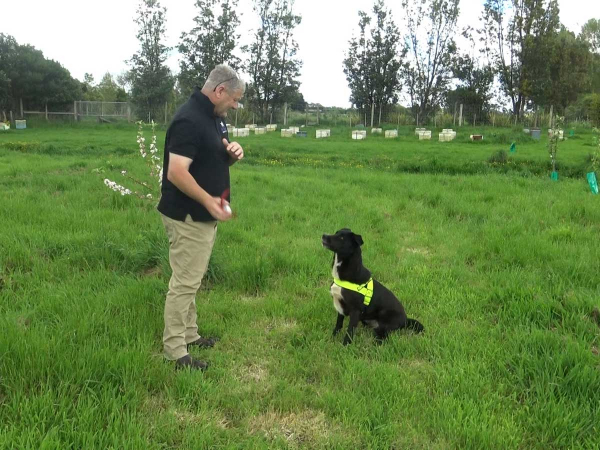
Training dogs to sniff out the bacterial disease American Foulbrood (AFB) in beehives could save New Zealand’s beekeeping industry several million dollars a year.
The Ministry for Primary Industries (MPI) is contributing $50,000 through Sustainable Food & Fibre Futures (SFF Futures) towards a one-year, $95,000 training project.
The project aims to develop a scientific methodology for training detection dogs to reliably detect AFB, by creating a ‘scent picture’ of the disease.
It’s led by DownUnder Honey in partnership with Pete Gifford from K9 Search Medical Detection Training Centre and Massey University researchers.
“A big part of the project is trying to come up with a pure form of the disease that can be grown in the lab, with no possibility of other scents in the mix,” says Jason Prior, owner of DownUnder Honey.
He says that the disease will be introduced to the dogs through a clinically sterile environment.
Prior explains that it’s not the first time dogs have been used to detect AFB but previous methods have led to inconclusive results in the field.
“When bees have AFB they often have other diseases.
“Previously dogs were trained on infected colonies without isolating the target scent. This project aims to overcome this issue, and produce more reliable detection dogs.”
He says that the new training will focus on detecting AFB spores and other relevant AFB bacteria that have come directly from a laboratory.
Overseas, AFB has been managed through the use of antibiotics but the disease has developed resistance over time.
New Zealand has always treated the disease through destruction of hives and hive equipment, which has a significant cost to industry.
New Zealand’s apiculture industry currently pays over $2 million in annual levies for beehive inspections.
“There’s almost a million beehives registered in New Zealand but we’re only physically inspecting around 4,000 hives a year,” Prior says.
“Unless we get some new tools like dogs to rapidly find the disease it gets more and more expensive to find that last five percent of the disease out there.”
The industry’s ultimate goal is to eradicate AFB, which would be a world first. Dogs can inspect an apiary of 20 hives within two minutes whereas an inspector could take at least 90 minutes.
Dogs can also be used to inspect stored equipment, allowing other sources of infection to be identified and destroyed.
MPI Director Investment Programmes Steve Penno says this project could be a gamechanger for New Zealand’s apiculture industry.
“Being able to detect the disease early would reduce lost production and the need to destroy hives. If successful, we’d be the first country in the world to use dogs to detect AFB. The detector dogs could be commercially available to farmers as a service.”
The project is also supported by the North Island Beekeeping Group and the Honey Industry Trust, which have contributed funding and will help with fieldwork.