MPI Opens $3m Greenhouse Gas Research Funding Round
The Ministry for Primary Industries (MPI) has announced has opened applications for the 2026/27 funding round of the Greenhouse Gas Inventory Research (GHGIR) fund.
 increase font size
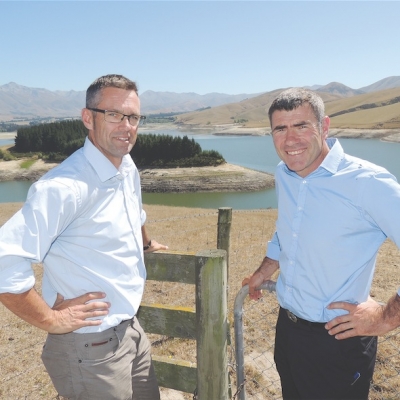 Opuha Dam chief executive Tony McCormack (left) with Nathan Guy.
Official declaration that the South Island’s drought is a medium-scale adverse event has been widely welcomed by farmers and their representatives.
Primary Industries Minister Nathan Guy made the announcement at a meeting of about 40 rural leaders, near Lake Opuha, last week before meeting media overlooking the dam for a photo call.
“The feedback from the meeting was that farmers have made early decisions… and by and large are coping well but the concern is the long-term forecast is for not a lot of rain,” he told Rural News.
Besides the immediate financial impact, which a speaker at the meeting said would already be $170-200,000 for a typical 3000 stock unit sheep and beef farm, the forecast means lack of winter feed is a mounting concern, said Guy.
MPI is working with Federated Farmers to compile an inventory, which will also include an assessment of likely PKE imports.
“We need to make sure there’s enough PKE coming in for the dairy industry and others that decide to use it.”
The adverse event declaration makes funds available for Rural Support Trust activities, facilitates tax tools such as provisional tax deferral and income equalisation, and provides welfare support in cases of extreme hardship.
Asked if the tax measures had come in time for deferral of provisional tax payments, the Minister answered the declaration “makes it easier for IRD to realise farms are in particular affected regions and are getting the necessary support.”
He declined to compare the scale and extent of the current drought with previous events which triggered declarations in the North Island.
“This is different. There’s a higher demand on irrigation across the South Island… I wouldn’t want to compare it with other droughts.”
Mackenzie Basin farmer Andrew Simpson was at the meeting and said it was good that Government has recognised the drought is a big issue.
“The winter feed issue is going to be critical… and there’s real concern for the store stock sales and whether everything’s going to find a home.”
Cast for age sales and autumn calf sales could also prove a problem, he warned.
“There could be an impact on the calf sales. It will depend on demand from the North Island.”
And as if feed wasn’t short enough anyway, rabbits are on the rise too.
“This is a season just made for rabbits. It needs to be recognised the impact they’re having… The South Island high country is in real need of the new strain of the calici virus.”
Greg Anderson, who farms upstream of Lake Opuha, was also at the meeting and welcomed the Minister’s announcement.
“I’m pleased with what they’re trying to do. It recognises the stress that’s out there in the rural community. It’s no silver bullet and there are no hand outs of money but there is some help for the Rural Support Trust.”
The ability to put money from capital stock sales into IRD’s income equalisations scheme, and take it back out without the normal mandatory six month wait, would be a real benefit of the declaration, he added.
“My concern is if we don’t get autumn rain is where will the stock go in winter. If the feed crops don’t yield we’ll either have to buy in feed of sell capital stock.”
Already all lambs have had to go store, where they’re normally finished, and while he “got lucky” sending a truckload away just before the price crashed, his average will be “$60 per lamb if I’m lucky, more likely mid 50s” compared to an $82/head average last season. And with the rams due to go out in a couple of months, it looks likely next year’s income will be hit too.
“My aim is to lose as little as possible this year, and not lose it again next year!”
The Ministry for Primary Industries (MPI) has announced has opened applications for the 2026/27 funding round of the Greenhouse Gas Inventory Research (GHGIR) fund.

AMINZ and the Ministry for Primary Industries (MPI) have partnered to develop a new Farm Debt Mediation video series aimed at farmers, creditors, and advisors.
Dairy continues to be the mainstay of the country's primary export earnings.
Don’t worry about it but just be aware - that’s the message from Ministry for Primary Industries (MPI) director-general Ray Smith as the H5N1 strain of bird flu is found in Australia.
OPINION: The latest update from the Ministry for Primary Industries (MPI) on the state of NZ's primary sector paints a positive picturee about its performance over the past 12 months.
New Zealand dairy farmers are set to be the first in the world to receive access to a new digital physical milk pricing tool that enables them to fix the price for their physical milk.
State farmer Pāmu is opening its farm gates this summer in an effort to give the rural sector the opportunity to see how large-scale, multi-system farming is delivering productivity and profitability across New Zealand.
A five-year study has found that the cost of reducing emissions without technology may be significant and unsustainable for Northland dairy farmers.
DairyNZ says Waikato farmers need certainty on Plan Change 1, but they say that certainty must be matched with practical, workable rules and a clear transition that doesn't get ahead of the new resource management system currently under review.
While the Government has moved quickly to make commercial hauliers' lot easier during the current fuel crisis, they appear to be stuck in the creep box when it comes to the agricultural industry.
Waikato farmers have been told that the Government’s new planning system legislation and the region’s Plan Change 1 (PC1) “won’t mesh together very well”.