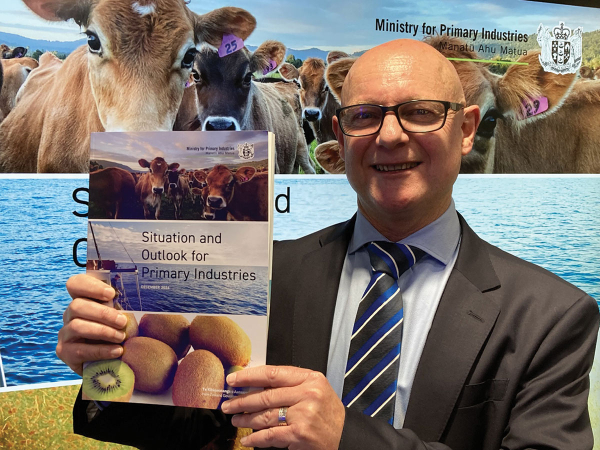
Ministry for Primary Industries (MPI) Director General Ray Smith believes there is potential for an increase in dairy farming in New Zealand.
Speaking to Dairy News at the launch of his organisation's latest outlook for the primary sector, Smith says the growth that NZ has got from the dairy industry is phenomenal and at present its growth is only being outstripped by the kiwifruit sector.
"But I think the changes in the RMA will allow for more diversification into dairy farming. NZ is unique in that it has the most efficient production system in the world and that's because our animals graze outside," he says.
The Situation and Outlook Report (SOPI) shows that export revenue from dairy for the year ended June 2026 will be up a mere 1% on the previous year and is likely to remain at the present level in the following 12 months. MPI attributes this to global supply outstripping demand and this has been reflected in the lower prices for WMP on the GDT - this past week being the exception.
When MPI prepared its report, it predicted a farmgate price of $9.70, but in December Fonterra was predicting a mid-point of just $9/kgMS.
Smith says last season's $10.20 payout was exceptionally high and the drop is a case of price correction.
He says a payout of around $9.00 is still good.
Read More:
The SOPI report says dairy farm expenses have "held flat" in the past season and the easing of monetary policy by the Reserve Bank has been hugely beneficial to the sector. It also points to a drop in interest rates as drivers for capacity and productivity growth in the sector.
The sale of Fonterra's consumer brands will also put more cash in the pockets of dairy farmers in 2026 which will somewhat counter challenging and subdued market conditions. One area singled out is China where there is an ongoing slump in dairy consumption, but lower local milk production there will likely support demand for more imported products.
A strong positive highlighted in the report is the increase in revenue from casein and protein products - these were up by 30% in the 2025 September quarter, compared with the same period in 2024. The US, NZ's largest protein market, grew by 39% in volume. This, says the report, is driven by demand for protein-dense products to prevent muscle loss.
The report goes on to say that "the proportion of US adults on weight loss medication has doubled over the past year" and that "the aging population in developed countries is another trend in driving protein consumption". The SOPI report says that worldwide export revenue from casein and protein products will increase 10% to $3.2 billion by June 2026.
While the numbers for dairy are static, there is still a belief that the situation is stable, but with the caveat that all sorts of factors, including geopolitical instability create a degree of uncertainty.