NZKGI Responds to Migrant Worker Exploitation Reports
Where any worker in the kiwifruit industry is mistreated, we expect the authorities to take action.
 increase font size

RAPID KIWIFRUIT post-harvest industry rationalisation is needed in the face of Psa, says EastPack chairman Ray Sharp.
Restructuring the industry down to two to four large post-harvest suppliers to Zespri - rather than the existing 20 plus of varying size – would bring a grower benefit of 30-50c a tray, Sharp told Rural News.
EastPack is proposing industry restructuring after the grower-owned cooperative announced a forecast result of $6.2 million for the year to December 31, 2012. The company says it has achieved efficiencies while retaining staff and anticipates some of the highest orchard gate returns in the industry (see sidebar).
Sharp says EastPack has seen the benefits of a good scale operation in lower packing prices and good returns.. “It is only something we have improved over the last three years,” he says.
All pack houses face lowered margins in the competition for reducing volumes in the Psa environment, he says. “A lot of post -harvest operators will struggle to make money,” he says. “As long as we have volume, we (EastPack) will continue to make money with the cut margins…. And that’s the sense in which we will try and lead the way, because we think we’ve seen the light.”
Sharp says rationalisation is desirable “rather than post-harvest operators continuing to defend their position to the last and losing viability”.
The industry does not yet know what the recovery situation may be and it may have to live permanently with lower volumes. “We think there is 30-50c a tray benefits for growers and owners by achieving that rationalisation. That is very significant when green growers are operating on very fine margins, due to challenged returns from the marketplace.
“Part of that challenge is the rising New Zealand dollar and the competition in the world market makes it impossible to continue to ramp up the sale price. So you’ve got to look for efficiencies in the systems between market and grower. Two avenues are the Zespri supply chain and the post harvest.”
Eastpack chief executive Tony Hawken says all post-harvest companies are scrambling to maintain their volume because of Psa.
“We’ve got a (financial) result that would be among the top echelon, so would be particularly enthusiastic about expanding our market share. It is logical with contracting volumes that those volumes are centred around the most efficient plants, not only efficient in terms of costs but also highest quality – they turn out a good product.
“If we all compete for ever shrinking volumes, there will be no real winners at the end of the day.”
Regarding industry moves he says “everyone is talking to everybody at this stage”. In the end growers will decide “because it is an industry pretty well dominated by growers”, Hawken says.
Where any worker in the kiwifruit industry is mistreated, we expect the authorities to take action.

Kiwifruit growers are watchful but remain optimistic as concerns around the potential effects of the El Niño weather pattern this season.
More signs of a booming kiwifruit sector.
After delivering a strong financial year, rural trader PGG Wrightson says the coming months will depend on customer confidence and weather.
New Zealand growers have always adapted to changing conditions, but one challenge is steadily gaining ground across the horticulture sector: resistance.


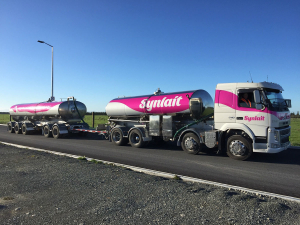
Synlait has swung to second-half profit as operations stabilise, but the dairy processor still posted a $75.4m annual loss.

LIC shareholders have elected a new North Island representative to the co-operative's Board, along with five representatives to its Shareholder Reference Group (SRG), following the company's Annual Meeting held in Invercargill.
Farmers across parts of Southland and South Otago are continuing to deal with difficult conditions after a prolonged run of wet weather, with pressure building around feed supply, stock management, pasture damage, farm infrastructure and everyday workloads.
Federated Farmers says it welcomes Labour's commitment to reviewing the Sharemilking Agreements Act, calling on other major parties to do the same.
For Canterbury dairy farmers Sian Meijer and Rick Wobben, wearable technology has become one of their most valuable on-farm tools - helping manage 1850 cows across an expansive, high-performing dairy operation while improving efficiency, mating outcomes and day-to-day decision making.
Fonterra has unveiled its annual results for the 2026 financial year, posting $27 billion in revenue and close to $20 billion returned to New Zealand farmer owners and unit holders.