New Reviva Forage Rape Wins Over Dryland Farmers in First Year
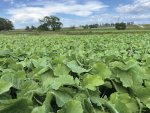
It's only just hit the market, but a new forage rape bred for dryland farms has already won the approval of lambs and young cattle both north and south.
 increase font size
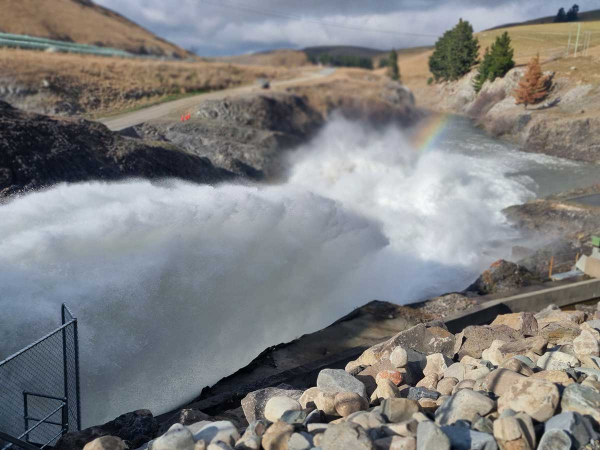
Opuha Dam's ability to protect South Canterbury communities from major flooding has taken a significant step forward, with Opuha Water Limited (OWL) successfully commissioning a new outlet valve capable of releasing record volumes of water from the dam ahead of a weather event.
By enabling larger controlled releases before a storm arrives, the new outlet allows OWL to build additional flood buffer within Lake Opuha while downstream rivers are still at normal levels — increasing the dam's ability to temporarily store floodwaters and helping reduce peak flood impacts further downstream.
The new Low-Level Outlet (LLO) valve was commissioned on 11 and 12 August 2026, marking one of the most significant safety upgrades undertaken since the dam was built.
During testing, it delivered a historic first for Opuha Dam, with total discharge flows through the penstock of approximately 52 cubic metres per second — equivalent to about 187,000 cubic metres of water, or roughly 75 Olympic-sized swimming pools, every hour.
The upgraded outlet features a new 1.8-metre diameter Fixed Cone Discharge (FCD) valve, utilising a branch of the penstock used during the dam's original construction, which had remained buried within the dam structure until now.
The project has been designed to significantly increase the dam's ability to safely release water before and during major weather events, giving OWL a powerful new flood management tool.
The new outlet can reduce Lake Opuha's water level by up to approximately 6.5% a day ahead of a predicted significant high-rainfall event. Depending on inflow volume, this would equate to 27–32% of the lake's volume released across a five-day period.
As well as reducing reliance on the dam's spillways, advanced dewatering protects downstream stopbanks, with the dam acting as a buffer for floodwaters.
The $8 million project is one component of the wider Opuha Dam and Irrigation Scheme upgrade, supported by a government loan of up to $20.8 million through the Regional Infrastructure Fund, administered by Kānoa – Regional Economic Development & Investment Unit.
Opuha Water Chief Executive Bjorn Triplow says the achievement represents an important investment in the safety of the dam itself, as well as the long-term safety and resilience of South Canterbury roads, rail, bridges, stopbanks, productive land and local townships.
"This is a landmark achievement for Opuha Water, our farmer shareholders, and the community," Triplow says. "The successful commissioning confirms that the new outlet is performing as intended and provides a significant increase in our ability to safely manage water levels ahead of and during major flood events.
"While Opuha Water's farmer shareholders have funded this investment, the benefits extend well beyond the scheme itself. Increased flood management capability enhances the resilience of critical downstream infrastructure, rural communities, and productive land throughout the catchment."
Commissioning included operation of the FCD valve alongside the hydroelectric generation plant. Together, the two systems achieved total discharge flows of approximately 52 m³/s — the highest controlled-release capacity through the dam's penstock since it was built.
"This project demonstrates the commitment of Opuha Water and its farmer shareholders to invest in infrastructure that not only supports irrigation and renewable energy generation, but also delivers lasting benefits for the wider region. It is an investment in community resilience and the long-term security of one of South Canterbury's most important strategic assets," Triplow says.
Triplow says that while the new valve represents a step forward in flood control, further work is needed to increase spillway capacity — a significantly more expensive undertaking.
"Given that the primary beneficiary of increased spillway capacity would be publicly-owned river infrastructure, OWL is keen to work with the wider community to explore how this could be progressed," he says.
It's only just hit the market, but a new forage rape bred for dryland farms has already won the approval of lambs and young cattle both north and south.
Federated Farmers president Colin Hurst and his family raised a glass of milk last week to toast the start of a new addition to their farming operation at Makihihi, south of Timaru.
Increased competition for water means the whole community is looking at how irrigators use water.
Moves are afoot to get a team of Australians over here to help repair North Canterbury's irrigation machinery, ravaged by the big windstorm of late October.
A major floodway infrastructure upgrade has been completed in Edgecumbe, providing enhanced flood protection and resilience for the local community.



National’s pledge to introduce 19 new national standards shows the party is serious about getting Wellington out of farming, Federated Farmers says.
The National Party’s policies to make it easier to grow fresh vegetables, secure reliable water and energy and simplify farm planning are practical changes that will give growers the confidence to invest, according to Horticulture New Zealand (HortNZ).
Fonterra Co-operative Group chief financial officer Andrew Murray has resigned to take up a role outside the dairy giant.
A major move is about to get underway to improve the quality and viability of dairy beef and cattle in NZ.
Veterinarians say changes to the code of welfare for dairy cattle provides a positive foundation for improved cattle welfare across the country.
Today, 15 October, is the International Day of Rural Women, which recognises rural women’s contribution to farming, communities and the environment.