
Patterson: Rural NZ Faces a "Massive" Infrastructure Deficit
The Minister for Rural Communities, Mark Patterson, says there's a massive infrastructure deficit in rural areas.




 increase font size
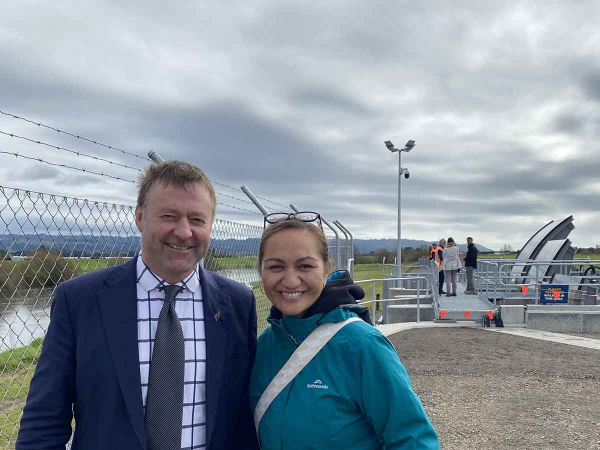 Associate Regional Development Minister Mark Patterson with Kawerau Mayor Faylene Tunui.
A major floodway infrastructure upgrade has been completed in Edgecumbe, providing enhanced flood protection and resilience for the local community.
The Rangitaiki floodway was opened by Associate Regional Development Minister Mark Patterson on Saturday, following 12 years of work.
The project was a six-stage project designed to take pressure off the flood-prone Ranigtaiki River stopbanks by diverting some of its flow during significant weather events.
The final stage included increasing the capacity of the floodway and the construction of an additional spillway to manage the water flows entering the floodway from the Rangitaiki River above Edgecumbe.
In August 2024, the Government committed $200m from the Regional Infrastructure Fund to flood resilience across New Zealand. The $50 million floodway was co-funded, with $14 million in government funding, and the balance of the project was funded by the Bay of Plenty Regional Council and local community.
Patterson says the project is one of the largest flood resilience projects completed in New Zealand in recent times.
"It will bring much needed flood protection for communities and will enable economic development opportunities in the Eastern Bay of Plenty," he says.
"We only need to think back to the 2017 Edgecumbe floods to realise how critically important this project is to the region," he says.
The floods saw water pour into the area after the Rangitaiki River burst its banks, causing millions of dollars in damage, displacing people, and disrupting the lives of many in the region for a considerable amount of time, says Patterson.
He says that upgrading the spillway and installing new floodgates will allow the Bay of Plenty Regional Council to safely manage and control the release of flood waters.
"Projects like the Rangitāiki Floodway upgrade represent core, resilient infrastructure, crucial to the economic, social, cultural, and environmental wellbeing of our country," Patterson adds. "They help to protect lives and reduce the toll these events can have on communities, businesses, and infrastructure."
"This project has been a testament to the partnership between central and local government, Rangitāiki River communities, and local Iwi and industry to support community resilience and economic growth in the Eastern Bay. I look forward to seeing this newly protected land being utilised for future growth opportunities that benefit the local economy," he concludes.
The Minister for Rural Communities, Mark Patterson, says there's a massive infrastructure deficit in rural areas.

National’s much-touted free trade deal with India featured in the Rural Issues Debate at Mystery Creek, Hamilton on Wednesday night.
It was billed as a chance for all the political parties to woo the rural vote, but question marks hang over just how effective this was.
Opuha Dam's ability to protect South Canterbury communities from major flooding has taken a significant step forward, with Opuha Water Limited (OWL) successfully commissioning a new outlet valve capable of releasing record volumes of water from the dam ahead of a weather event.
Just a matter of hours after Indian Prime Minister Narendra Modi's historic trip to New Zealand, the political doors in India swung wide open for Associate Minister of Agriculture, Mark Patterson, who was there to help promote our high-quality coarse wool.


National’s pledge to introduce 19 new national standards shows the party is serious about getting Wellington out of farming, Federated Farmers says.
The National Party’s policies to make it easier to grow fresh vegetables, secure reliable water and energy and simplify farm planning are practical changes that will give growers the confidence to invest, according to Horticulture New Zealand (HortNZ).
Fonterra Co-operative Group chief financial officer Andrew Murray has resigned to take up a role outside the dairy giant.
A major move is about to get underway to improve the quality and viability of dairy beef and cattle in NZ.
Veterinarians say changes to the code of welfare for dairy cattle provides a positive foundation for improved cattle welfare across the country.
Today, 15 October, is the International Day of Rural Women, which recognises rural women’s contribution to farming, communities and the environment.





OPINION: The same mainstream media muppets that brought you Jacindamania in 2017 have been flat out pimping for the Opportunities…
OPINION: Your old mate reckons the atrocious way farmers in the UK are treated by their lords and masters in…




