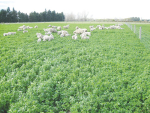
B+LNZ Urges Farmers to Graze Lucerne Hard Before Winter Weed Control
Beef + Lamb New Zealand is reminding farmers with lucerne stands to graze them hard over the next few weeks in preparation for a winter weed control programme.
 increase font size
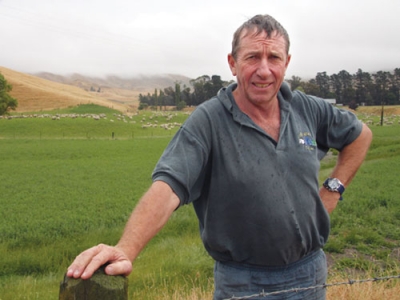 Doug Avery.
“The only reason I’m here is because I failed.” How often have you heard a farming event opened with a line like that?
It was Marlborough farmer Doug Avery’s opening comment to an audience of about 100 in Fairlie last month – one of his ongoing Resilient Farmer tour events.
“But out of my hard time came my greatest opportunity,” he continued, recounting how years of drought drove him to the brink but then changes to his farming system, and return of son Fraser to the farm, revitalised his outlook.
Today, Avery’s lucerne story is legend (Rural News told it in 2008) but his Resilient Farmer tour message isn’t about lucerne, it’s about willingness to change, and if things aren’t going well, to seek help. “Farming made this country what it is but we seem to have got into a rut.”
Small, incremental changes add up over the years; the important thing is to make a start, he stresses.
For example, switching his land to lucerne has produced $37,500/ha in the past 15 years, while similar neighbouring country in traditional pasture has done only $4200/ha. “There were only a few degrees of separation at the start but further out it becomes a huge difference.”
Now his “hot pastures” return $3000/ha, and he has 450ha of them, while traditional ryegrass “horrid pasture” returns just $280/ha. Turnover has gone from $320,000 in 1998 to $2.2m.
Ewes scanned 203% last year and 93% of lambs went by weaning at 105 days averaging 21kg carcase weight, leaving land free to finish trading stock, or destock and “go to the beach” if drought limits growth.
Without high quality feed, sheep will never demonstrate their genetic potential, he adds, advocating a 74% legume, 26% other pasture diet. “When you achieve that you’ll find the genetic potential of your animals.”
Avery describes life as a series of peaks and valleys. You can’t stay on the peaks forever but as you leave one peak you should have your next peak in sight and use the valley between to your advantage. “To climb new mountains I had to learn a whole load of new stuff.”
Reacting when the crisis or opportunity hits is too late, so talking about lucerne as a solution to drought when the drought’s on is too late. “Do the work to build resilience before the events.”
Collecting data and then crunching the numbers to analyse and assess performance, and alternatives, is vital, says Avery, who talks about three types of work on a farm: practical, paying $18-25/hour; tactical, earning $100/hour; and strategic, returning $300 to $1000/hour. It’s too easy to spend all your time on the practical with little or no time on the other two, he says.
“If you don’t do this [tactical and strategic] stuff you don’t know what you’re missing out on and I’d suggest you are exposing yourself to risk.”
Avery says farm management package Farmax “is the most important tool we use”.
Every animal is EID tagged so, for example, when drought hits he knows which are the worst performing 25% to get rid of. “It might mean you only lose 8% production… the current [drought] situation is a great opportunity to get rid of those lowest performers.”
Key points
Beef + Lamb New Zealand is reminding farmers with lucerne stands to graze them hard over the next few weeks in preparation for a winter weed control programme.
Business Advisors and Accountants (BFA) and Craigs Investment Partners will be hosting an event later this month where they will take a deeper look at the practical and emotional side of succession planning.
Lucerne is the world’s most important forage, says Lincoln University professor of plant science Derrick Moot.
Long-time lucerne expert and advocate Professor Derrick Moot of Lincoln University says he’s now getting interest in his work from around the world.
Biocontrol measures that helped Australian farmers control a serious dryland weed for 20 years may at last benefit New Zealand.


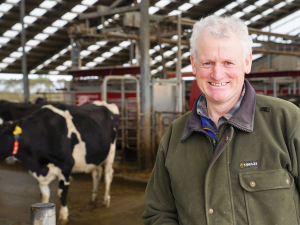
In Dacre, near Invercargill in New Zealand’s South Island, Bruce Dinnington is running a dairy operation unlike any other.

A free online platform aggregating governance vacancies across rural and regional New Zealand has been launched.
Environment Minister Nicola Grigg has announced details of a new rural plastics recycling scheme.
Agricultural drone operators say that a government decision to allow lower-risk drone work without certification won’t lower standards but drive innovation and efficiency.
OPINION: Warning bells are ringing in the arable sector.
Farmgate lamb prices are down by 8%, beef cattle by 4.5% and farm expenditure up by 4.2%.