Krone XDisc 710 Now Fits John Deere, New Holland Foragers
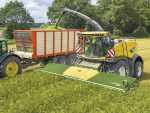
Krone's XDisc 710 direct-cut header can now be used by John Deere and New Holland forage harvesters, as well as the Krone Big X it was originally designed for.
 increase font size
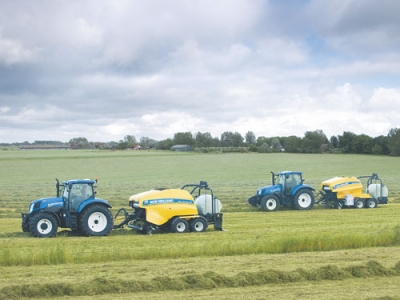 The saying once was roller balers for grass and belt balers for straw...
The saying once was roller balers for grass and belt balers for straw...
But advances in design over the last decade mean that either format seems capable of dealing with all crops, so you need only decide whether you're happy with one-size-fits-all or whether you need bales of varying diameter?
Already well known and respected for its range of Belt Balers, New Holland importer CB Norwood Distributors has recently announced the launch of the new fixed chamber Roll Bale range comprising three options: the RB 125 Baler, the RB125 Combi or the RB 135 Ultra (combi); the numerals indicate bale diameter, Combi signifies the bale wrapping system, and Ultra shows that the machine is heavy duty and orientated to arduous conditions.
Core of the machines is a bale forming chamber comprising 18 heavy duty and wear resistant rollers of 200mm diameter with aggressive profiles to keep bales rotating in all stages of bale formation, or difficult crop or climatic conditions. The designers claim that the higher number of rollers than on competitor machines results in a greater surface area in the bale chamber, helping to spread the loadings created by high density bales, and thereby prolonging the operating life of the machine.
Up front a 2.1m working width pickup on the RB 125, or 2.2m wide version on the RB 135, both use five tine bars to achieve a clean pickup behind even the widest swaths.
Crop is fed from the pickup to a 470mm feeder rotor made from Hardox 500 steel, with 10mm thick feeder fingers. These in turn push the crop through a chopper bank comprising 20 retractable knives.
If overloaded, a hydraulic cut-out disconnects drive to the pickup and feeder rotor allowing bale formation to carry on. On the RB 135 version, in cab rotor reversing allows easy clearance of blockages.
Once formed, bales can be covered by conventional net wrap or the operator can chose to use an optional film wrap system to cover the circumference of the bale. This excludes air, improves the fermentation process and helps maintain bale shape; it also has potential to reduce overall wrapping costs, as fewer layers of film wrap are needed to cover the bale, or lower quality wrap options can be specified.
Control of the whole system is via an in-cab monitor with a large easily read display giving information on bale density, pto speed, net or film indication and the number of layers per
bale, plus the ability to record bale counts; an internal memory for up to 50 jobs should help simplify invoicing in busy periods.
With a low centre of gravity, gradients and slopes should not pose any problems, and a choice of tyres will allow tailoring the machine to operating conditions. The RB 125 is available with super-wide 500-22.5 flotation tyres, and the 125 and 135 combi units can take 500-50R17 items, all of which stay within a 3m transport width.
Servicing is looked after with a lightweight, one piece forward cover which lifts to give easy access to the centralised auto greasing system, and the drive chains have auto lubrication.
Krone's XDisc 710 direct-cut header can now be used by John Deere and New Holland forage harvesters, as well as the Krone Big X it was originally designed for.
ZED, the dedicated wholesale division of CB Norwood Distributors, and the importer and distributor for Kuhn in New Zealand, has announced investment in local expertise and stock availability for customers in 2026.
Creating a great deal of enthusiasm at Agritechnica, the T5.120 ‘Il Trattore’ styling concept tractor was celebrating the legacy of research and development, engineering, and design expertise, with the concept bearing a striking green and red colouring and styling inspired by the original first Fiat tractor, the Fiat 702 and the ‘Made in Italy’ logo.
First unveiled in 2023, New Holland has announced the addition of the T7.270 Methane Power CNG (Compressed Natural Gas) tractor to the recently expanded T7 Range.
A group of eight Giltrap Agrizone customers travelled to Europe in July with managing director Andrew Giltrap, taking the opportunity to visit St Valentin, Austria, to see New Holland tractors being built.



LIC shareholders have elected a new North Island representative to the co-operative's Board, along with five representatives to its Shareholder Reference Group (SRG), following the company's Annual Meeting held in Invercargill.
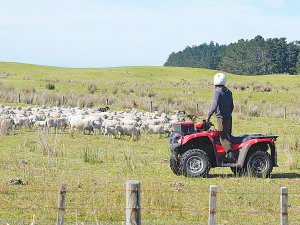
Farmers across parts of Southland and South Otago are continuing to deal with difficult conditions after a prolonged run of wet weather, with pressure building around feed supply, stock management, pasture damage, farm infrastructure and everyday workloads.
Federated Farmers says it welcomes Labour's commitment to reviewing the Sharemilking Agreements Act, calling on other major parties to do the same.
For Canterbury dairy farmers Sian Meijer and Rick Wobben, wearable technology has become one of their most valuable on-farm tools - helping manage 1850 cows across an expansive, high-performing dairy operation while improving efficiency, mating outcomes and day-to-day decision making.
Fonterra has unveiled its annual results for the 2026 financial year, posting $27 billion in revenue and close to $20 billion returned to New Zealand farmer owners and unit holders.
The first major update to the Dairy Cattle Code of Welfare in more than a decade has been released, marking what DairyNZ describes as an important step in ensuring animal welfare standards continue to evolve alongside scientific evidence and on-farm realities.