It's apparent that New Zealand farmers and contractors accept the benefits of high-spec, tractor-drawn tipping trailers: a wide range of brands were on display at Fieldays.
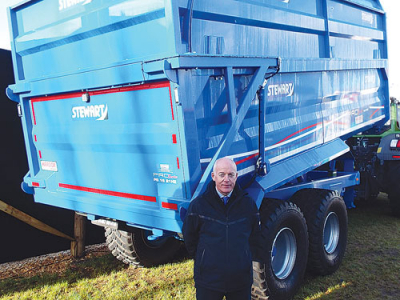
Stewart Trailers’ principal James Stewart, whose company is known for making high quality trailers in the UK, was busy scoping out the NZ market at Mystery Creek.
Based at Aberdeen, in the north of Scotland, and run by husband-and-wife team James and Mandy Stewart, the company goes back 30 years.
It works at building a better-quality trailer using current and evolving technology and, importantly, listening to customers’ experiences and requests. So Stewart has been an early adopter of flotation tyres and air suspension and braking systems.
Its range includes tippers, dump, flat, low-loader and livestock trailers. The Edge series starts with a single axle, 4-tonne monocoque and extends to the Edge 16, tandem axle 16 tonner. Likewise, the higher-spec GX series are built from mild steel from 11 to 20 tonnes or 15-26cu.m capacities.
For those looking to benefit from Stewart’s leading design and technology, the Pro Series, multi-purpose tippers use Hardox steel in their body construction.
This is said to have twice the strength of mild steel, allowing the bodies to be made lighter – reducing the tare weight but still retaining the required strength and durability.
“We’ve already sold a number of trailers in NZ, which interestingly have been built with a wider track for increased stability,” Stewart told Rural News.
The company’s Pro-Series trailers are fitted with high-speed, 10-stud commercial grade axles rated to 100km/h; these are typically fitted with truck-spec, 4-wheel braking with load sensing and ABS.
Designed to follow well behind the towing vehicle, the trailer’s design details, e.g. the monocoque body main rails folding outside the main chassis rails, keeps the centre of gravity low.
This also offers the advantage of preventing mud from collecting on exposed beams, and a sprung drawbar helps improve ride quality.
Though the company builds ‘standard’ trailers, Stewart notes that users regularly customise their trailers to suit an operation or the environment. Contractors are likely to specify air brakes, and farmers might ask for a load-sensing hydraulic braking powered by the tractor’s hydraulics.
Larger units are often supplied with hydraulic steering and, as on the unit displayed at Fieldays, a hydraulic parking jack. Other favourites include hydraulic drop-front panels, integral weighing and auto-greasing systems.