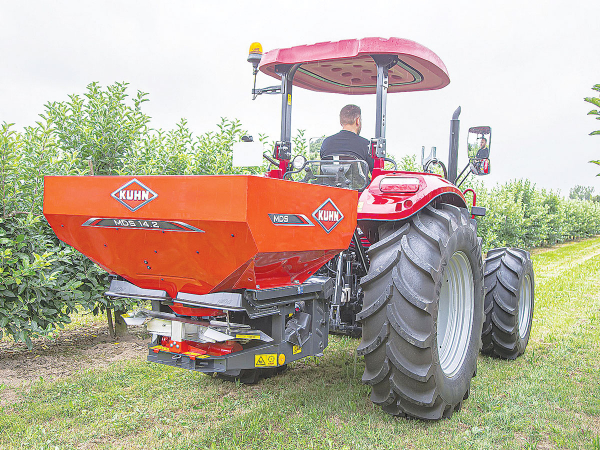
Kuhn says it has updated its MDS range of fertiliser spreaders, which offer farmers more options and provide machines that can be upgraded as their farming situation changes – without the need to buy a whole new spreader.
The slimline design of the MDS 8.2 and MDS 14.2 machines, with 1.08m and 1.40m widths respectively, are intended for use in special crops planted at narrow row spacings. This makes these spreaders suitable for vineyard and orchard applications.
The MDS 18.2 and 20.2 models are intended for mixed farming operations. These spreaders offer maximum capacities of 1,800 and 2,000 litres respectively, combined with a flexible hopper extension system to ensure maximum in-field output and reduced return trips for refilling.
Looking at control systems, the K and D versions are fitted with individual shutter slides operated by single or dual-acting hydraulic cylinders, directly from the tractor. For more precise control, an electric metering outlet control uses one actuator for each outlet, controlled by the simple E-Click switch box.
For even greater precision, including variable rate control, Quantron A terminals electronically adjust the metering outlets to maintain a consistent flow rate relative to ground speed.
During spreading, operators can adjust application rates and simultaneously close either side with a simple button. The system also includes the Varispread 8 function, allowing section control of four areas on each side of the machine, which is either controlled manually or by GPS.
For specialised spreading in orchards and vineyards, a 2-row spreading device manufactured in stainless steel, delivers fertilisers to the root area of row crops and ensures no material falls in the machine track. This device is easily adjusted to suit row distances of 2m and 5m without tools.
The MDS 14, 18 and 20 .2 machines can also be equipped with a spreading device designed for row crops such as maize, strawberries or vegetables. This allows precise delivery of fertiliser to seven rows at the same time.
Easily adjusted for different application rates and row spacing, the device saves fertiliser and helps with environmental issues.