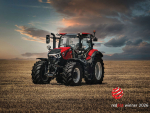
Case IH Unveils Next Generation Puma Series Tractors
Case IH has unveiled its redesigned next generation Puma Series tractors, said to offer improvements in connectivity, operator comfort, fuel efficiency and drivability.
 increase font size
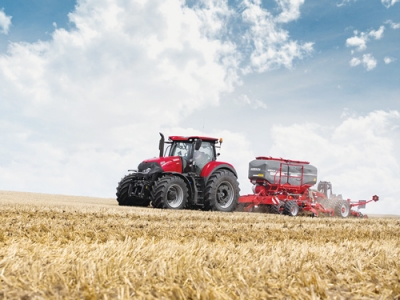
Witch tractors of 250-300hp favoured by many cropping farmers and contractors it's no surprise to see Case IH launch the Optum series.
With 270 or 310hp on tap, the series is designed to be versatile and able to do heavy draft work, yet be equally at home with PTO and transport duties and sit between the high-powered Puma or lower powered models from the Magnum range.
Christian Huber, Case IH vice-president of tractor product development, envisages that users of the larger Pumas and smaller Magnums will migrate to the Optum. He sees development of the range being dictated by customer demand in respect of more models.
The 6.7L FPT engine used in the Puma is installed in the new series, though it uses a heavy duty load bearing sump that negates the need for any chassis or side rails and so improves turning radius. The design still allows a maximum gross vehicle operating weight of 16 tonnes.
Interestingly, the engines do not offer 'boost' features for output, but rely on a setup that delivers rated power at all times, so what you see on the hood is what you get.
This is supplemented by a rethink on emission controls with the new Hi-eSCR after-treatment that relies solely on Ad-Blue and removes the normally standard exhaust gas recirculation system.The company says this results in the ability to tune the engine for best power and torque characteristics, and certainly the resultant torque figures of around 1300Nm between 1200 and 1800 ERPM look healthy.
Also of interest is a new 'exhaust flap' system that helps to control engine temperatures, but can also double as an exhaust brake which confirms the tractor's aspirations to perform transport duties. When the brake pedal is applied it works in conjunction with the variable geometry turbo which reverts to maximum volume and increases back-pressure in the engine. These and the variable cooling fan that serves to sap engine power combine to increase braking power by up to 40%.
For those envisaging a high percentage of transport duties this feature should help to save fuel and reduce wear and tear in the brake and drive line components.
The engine is coupled to the well sorted Case IH constantly variable transmission and, like its higher horsepower LWB Puma cousins, uses a four range gearbox. The box is beefed up for the Optum to handle the extra power and torque and can be specified in 40 or 50km/h variants.
The final drive system of the units uses double reduction hubs to allow rpm's to be kept up while keeping stress down, but importantly delivering high torque to the wheels. A choice of flange or bar axles is available, though the latter is likely to be the preferred choice in NZ; 2.15m diameter tyres or 900-85R42 size can be fitted to the rear.
Although much of the tractor is Puma derived, the front end is taken directly from the robust Magnum series. It uses the same saddle frame design mounted directly to the sump which saves parts as well as wear and tear. A suspension system is incorporated that offers 110mm of travel and uses an adaptive dampening system dependant on vertical loads.
At the business end of the tractor, a choice of 4- or 2-speed PTO systems are available with the added benefit that a PTO brake function can be incorporated into the headland management sequence to prevent 'wind down' of driven implements on headland turns. The Cat 3 rear linkage has a lift capacity of around 11 tonnes at the ball ends and couples with a front system that will lift 5.8 tonnes.
The hydraulic system can be optioned at either 165 or 220L/min using a variable displacement load sensing format and though shared with the transmission this sees greater takeout capacity than the Puma, by means of an additional reservoir mounted under the central housing. This improves capacity without raising the oil level in the transmission, that tends to cause parasitic power loss if gears become submerged in oil, which is the norm in overfill situations.
Up on top of the tractor, it's a case of status quo with the cabin using the same frame as the Puma and the Maxxum ranges, as well as the same layout and operating logic. Updates include the latest generation headland management control and a host of machine options, which include the like of AccuGuide auto steering, seat options and numerous lighting packages.
With a new aggressive design that will eventually become the new Case family look these tractors are going to capture some of this important market sector, but Kiwis are going to have to wait until the start of 2016 before they can touch one.
Case IH has unveiled its redesigned next generation Puma Series tractors, said to offer improvements in connectivity, operator comfort, fuel efficiency and drivability.
While it took some time for Wakanui farmer Eric Watson to get the tracks dirty on his new Case IH AF10 combine, he says it was worth the wait, with the challenging conditions really putting the new machine through its paces.
While equipment sales teams bask in the glory when they sell a product, they often forget the designers and engineers who bring that product from an idea to production.
The Case IH Farmall C, well known across New Zealand, has just seen an upgrade including a new look, increased weight and hydraulic power, and a cab overhaul.
Case IH has released details of its all-new round balers and redesigns to its large square balers aimed at increasing productivity.


In Dacre, near Invercargill in New Zealand’s South Island, Bruce Dinnington is running a dairy operation unlike any other.

A free online platform aggregating governance vacancies across rural and regional New Zealand has been launched.
Environment Minister Nicola Grigg has announced details of a new rural plastics recycling scheme.
Agricultural drone operators say that a government decision to allow lower-risk drone work without certification won’t lower standards but drive innovation and efficiency.
OPINION: Warning bells are ringing in the arable sector.
Farmgate lamb prices are down by 8%, beef cattle by 4.5% and farm expenditure up by 4.2%.