As most of South Canterbury’s farmers grapple with drought, about two dozen in the hinterland of Waimate will be hoping this is their last.
They’ve bought into the Waihoa Downs Irrigation project, a subsidiary of Morven Glenavy Irrigation (MGI) which will bring reliable Waitaki water to just under 3300ha of their properties.
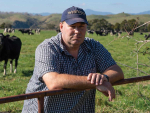
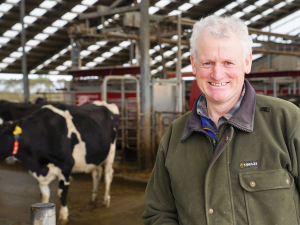
“In my situation it will give me an engine room,” sheep and beef farmer Henry Dyer told Rural News at the official ceremony to mark the start of construction.
“I’m doing 50ha at this stage but there’s the potential to do 120ha.”
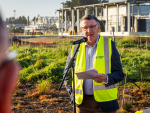
Scheme instigators, Robin Murphy of MGI and John Kirk, deputy chairman of Waihoa Downs, explained how it had taken fourteen years for the concept of lifting Waitaki water into the Waihoa catchment to reach construction.
“There was a four or five year hiatus in the middle due to the Waitaki [allocation] Plan but it’s gained real momentum in the last two or three years,” said Murphy.
“The turning point was when we went away from trying to do 5500ha and went with the hardcore of farmers who fully supported it.”
That decision cut the design specifications and cost for stage one to $30m which farmers have funded with $1500/ha shares.
An annual charge, anticipated to be about $800/ha in a typical year, will be due hereafter, the exact figure depending on how much water is required each year.
“In a dry year it will cost more because we’ll use more power.”
The power is to pump water up 6.5km of 900mm pipe to a pond at 217m above sea-level on the edge of the Waihao valley, from which it will flow down a backbone and rib network of pipes to the farms.
“It will be under pressure but not sufficient pressure to run the irrigation systems on most of the farms.”
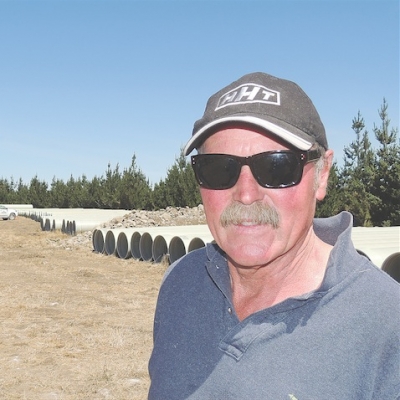
The build programme is 204 days using fibreglass pipes from Saudi Arabia dug into trenches up to 4m deep. Allowing for no-work days due to wet ground over winter it’s hoped water will be available on farm by spring 2016.
“Some of the ground is quite steep and this land can get very greasy in the wet,” project manager Grant Mehrtens of Rooney Earthmoving explained.
Kirk says they’re already taking “expressions of interest” in stage two of the scheme, which could take the area to 6600ha, but no decision on whether to progress that will be taken until stage one is complete and operating.