Turning data into dollars
If growing more feed at home adds up to $428 profit per tonne of dry matter to your bottom line, wouldn’t it be good to have a ryegrass that gets you there quicker?
 increase font size
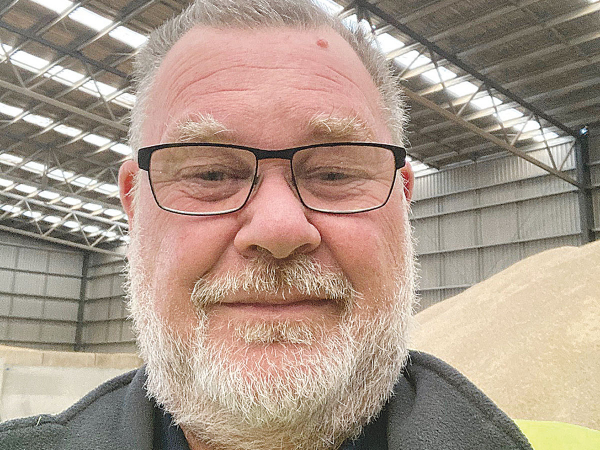 GrainCorp’s new Timaru facility supervisor Martin Wynen.
Feed company GrainCorp claims its new blending facility in Timaru will give South Island farmers more choice and flexibility when choosing feed product for animals.
GrainCorp Feeds general manager Daniel Calcinai reckons farmers are moving away from bulk, lowest cost commodities, to feed solutions best suited to individual farms.
He says they are offering farmers nutritional expertise and the product range they need to keep their herds healthy and productive.
“Today’s farmers are looking for access to high quality, innovative and cost-effective dairy feeds they can tailor to suit the nutritional requirements of their herd,” Calcinai says. “Pasture remains the key ingredient, followed by home-grown supplements.”
The company says it will work with farmers to help maximise feed utilisation, by recommending the right supplement at the right time.
“What worked last season may not be the best solution this season. That is where our team can help.”
Calcinai says farmers are diversifying their feeding regimes and using a combination of both dry and liquid products – often with additives such as trace minerals, toxin binders and bypass fats, to help enhance the health and performance of the cow.
“More and more farmers are making feeding decisions based on factual information and hard data,” he adds.
“They’re also turning to technology and unique monitoring tools like our Tracker programme to help them.”
Tracker is an online tool developed to help make fact-based farm and feeding decisions, while providing the ability to monitor outcomes.
“It helps take away the guess work and makes decision making easier,” Calcinai says.
From its new plant in Washdyke, Timaru, GrainCorp Feeds products include crushed grains, proteins, such as DDG and soybean meal; fibre and energy-based products, such as soyhull pellets; and dry matter replacements, such as PKE.
Calcinai says soyhull is low cost and contains a good level of protein and energy.
“Being low in starch, it is safe to feed ad-lib, making it the ideal complement to PKE in bulk or in-shed feeding situations during spring.”
He says the company’s focus is on feeding dairy cows and Timaru, with its port facilities, is an important dairy feed hub within the South Island.
“It also complements our existing liquid feed storage and blending facilities at the Port of Timaru, where we have been situated for several years.”
Timaru's top man
Martin Wynen has been appointed as GrainCorp’s new Timaru facility supervisor.
“Martin has significant experience in feed storage and handling, enabling a quick set up and peace of mind in our blending operation,” Calcinai says. “With Martin’s knowledge and experience, we look forward to working farmers to deliver the very best products and services across the Central and Upper South Island.”
He adds that the company has a proven model to help farmers meet their production and reproduction goals.
If growing more feed at home adds up to $428 profit per tonne of dry matter to your bottom line, wouldn’t it be good to have a ryegrass that gets you there quicker?
When buying supplementary feeds, farmers need to consider the entire package on offer – service, freight and all the components in a feed mix – not just focus on the price of the cheapest component – palm kernel meal, according to J. Swap Stockfoods sales manager Joe Hardman.
Two high producing Canterbury dairy farmers are moving to blended stockfeed supplements fed in-shed for a number of reasons, not the least of which is to boost protein levels, which they can’t achieve through pasture under the region’s nitrogen limit of 190kg/ha.
OPINION: Few things are more stressful for dairy farmers than running out of feed when cows need it most.
Now is not the time to stop incorporating plantain into dairy pasture systems to reduce nitrogen (N) loss, says Agricom Australasia brand manager Mark Brown.


Farmer-owned fertiliser company, Ballance Agri Nutrients is welcoming National’s plan to negotiate security agreements with key supplier countries to protect New Zealand-bound products from export restrictions and greater supply chain certainty.

Carrfields has announced the appointment of Stu Hall to the newly created role of chief operating officer, Carrfields Ltd, reflecting the continued growth of their agribusinesses and the need to ensure the company has the leadership capacity and support in place as it pursues the emerging opportunities ahead.
New Zealand's role is not to compete with Indian growers, according to NZ Apples and Pears.
The potato industry is celebrating the success of two rising stars - James Blair, the 2026 Young Grower of the Year and runner-up and innovation award winner, Amber Davy.
Twenty-eight emerging leaders from across the horticulture sector spent two days last month learning valuable skills and connecting with industry experts.
There are five entrants in this year’s Young Horticulturist of the Year, competing in a series of technical, practical, business and leadership challenges.